
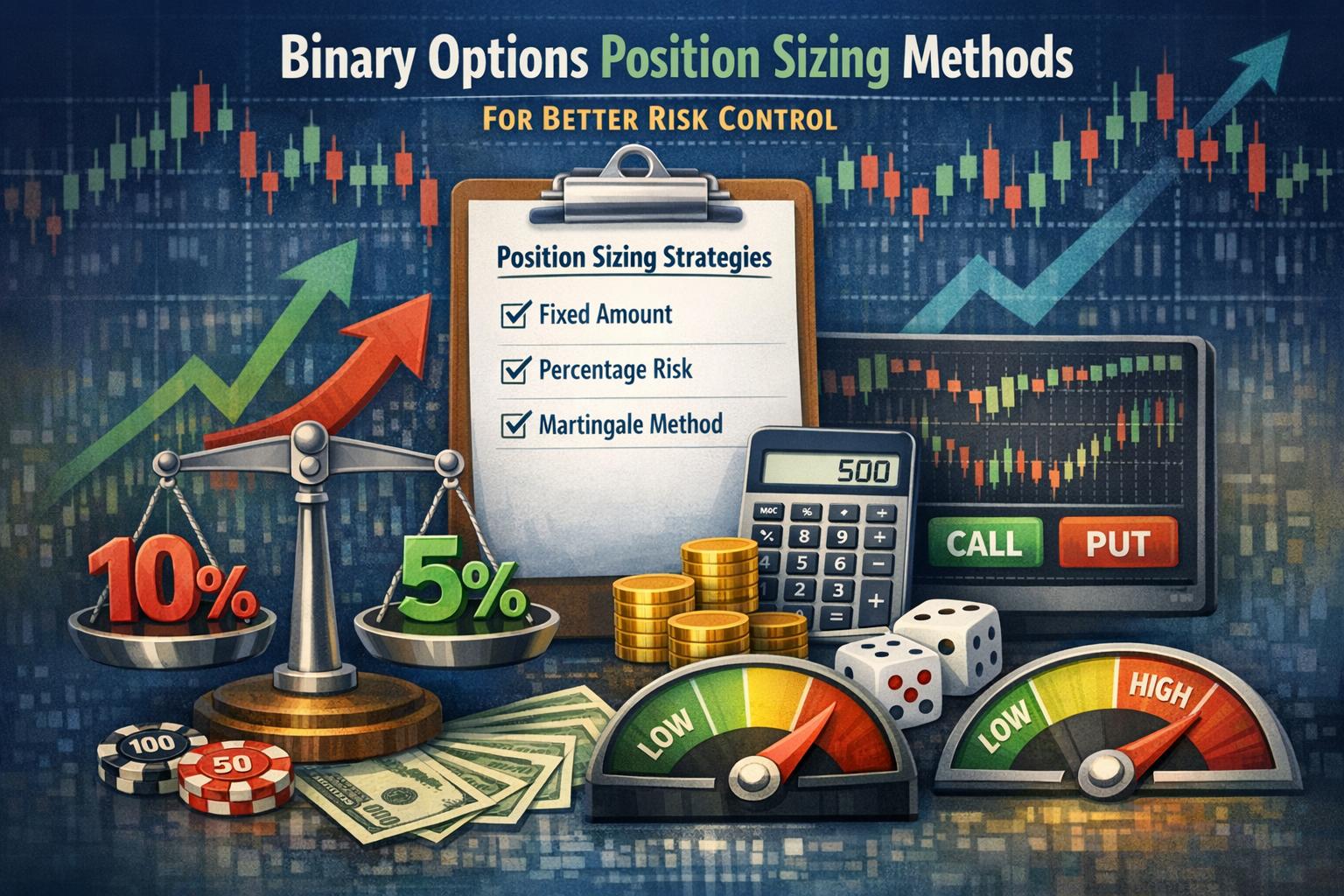
Understanding Position Sizing in Binary Options
Position sizing is a critical component of a structured binary options trading strategy. It refers to the process of determining how much capital to allocate to a single trade in relation to the total trading account. In binary options, where outcomes are fixed and time-bound, position sizing plays a particularly important role because each trade typically results in either a predetermined payout or a complete loss of the invested amount.
While many traders focus primarily on identifying entry signals, technical indicators, or market trends, the sustainability of a trading approach often depends more on how capital is managed than on how trades are selected. A consistent position sizing framework enables traders to define their exposure clearly, set boundaries for acceptable risk, and avoid disproportionate losses. Over time, these decisions directly influence capital preservation and overall account growth.
Importance of Position Sizing
Binary options trading involves forecasting whether the price of an asset will rise or fall within a specified time frame. Because returns and losses are typically fixed percentages of the invested amount, each decision has a clearly defined financial consequence. Without structured position sizing, traders may allocate inconsistent amounts across trades, leading to unpredictable risk exposure.
The importance of position sizing lies in its ability to manage drawdowns. A sequence of losing trades is statistically inevitable in any trading system. If too much capital is committed to each position, even a short losing streak can significantly impair the trading account. By contrast, a disciplined allocation method reduces the impact of losses and extends the trader’s ability to remain active in the market.
Another essential aspect is capital efficiency. Allocating too little capital per trade may limit potential returns and slow account growth. Allocating too much may increase volatility in account balance. Position sizing provides a structured method to balance opportunity and protection. In binary options, where payouts often range between 60% and 90% of the stake, understanding how much to commit relative to the overall account is foundational.
Risk Management through Position Sizing
Risk management and position sizing are closely connected. In binary options, the maximum loss per trade is usually known in advance: the entire investment amount. This clarity simplifies planning but does not eliminate risk. The key question becomes how much of the total account should be exposed to that fixed-loss possibility.
A well-defined position sizing approach limits account exposure to a predetermined percentage per trade. For example, if a trader chooses to risk 2% of a $5,000 account, the maximum exposure per trade would be $100. Even if five consecutive trades result in losses, the account would decline by approximately 10%, preserving most of the capital for future opportunities.
Such an approach supports long-term participation. It allows traders to withstand normal statistical variance without compromising their ability to recover. Without this planning, repeated losses can lead to rapid depletion of funds, limiting the trader’s ability to continue applying their strategy.
Position sizing also reduces reliance on reactive decisions. When exposure levels are pre-established, trade size becomes a mechanical calculation rather than a subjective choice influenced by recent outcomes. This contributes to consistency and removes the need to make frequent discretionary adjustments under pressure.
Basic Position Sizing Techniques
Binary options traders typically rely on straightforward methods when determining trade size. These techniques differ in flexibility and responsiveness to account changes.
1. Fixed Dollar Amount
The fixed dollar method involves committing the same monetary amount to every trade. For instance, a trader may decide to invest $50 or $200 per trade regardless of fluctuations in account balance. This method is easy to implement and offers predictability.
Its main strength lies in simplicity. Calculation errors are minimized, and trade execution remains consistent. However, this strategy does not adjust to gains or losses. If the account increases significantly, a fixed stake becomes proportionally smaller and may reduce growth potential. Conversely, if the account declines, the fixed amount represents a growing percentage of available capital, increasing risk exposure.
Because binary options returns are fixed, a static position size may limit adaptability. This method may be appropriate for traders who prefer stable investment amounts and operate with relatively large accounts where a fixed amount represents a small percentage of total capital.
2. Percentage of Account Size
A more adaptive approach involves risking a fixed percentage of the total account balance on each trade. Traders commonly choose between 1% and 3%, depending on risk tolerance and strategy performance metrics.
Under this method, position size automatically adjusts to account performance. If the account grows, trade size increases proportionally. If the account declines, trade size decreases, helping preserve remaining capital. This proportional adjustment supports long-term balance between risk and reward.
For example, in a $10,000 account risking 2%, the trade size would initially be $200. If the account increases to $11,000, the next trade would be $220. If it declines to $9,000, the next trade would be $180. This dynamic scaling creates a self-regulating system.
In binary options, where each loss is total for the stake, many traders find the percentage method more sustainable. It accounts for account volatility while maintaining disciplined exposure across different market conditions.
Evaluating Risk-Reward Characteristics in Binary Options
Position sizing should also reflect the payout structure of binary options contracts. Unlike traditional trading instruments, binary options often offer returns less than 100% of the invested amount on winning trades. For example, a successful trade might yield an 80% return, while an unsuccessful one loses 100% of the stake.
This asymmetry affects the break-even win rate. If the payout is 80%, the trader must win more than 55% of trades to maintain profitability. When determining position size, traders must account for this statistical requirement. Larger position sizes magnify the impact of both wins and losses under this payout structure.
A practical approach combines position size with expected win rate. If a strategy has been tested and historically produces a 60% win rate with 80% payouts, managing exposure at 1–2% per trade may balance moderate risk with sustainable growth. If the win rate is less stable, a lower percentage allocation may be more appropriate.
Advanced Position Sizing Strategies
Beyond basic fixed and percentage-based methods, some traders experiment with dynamic position sizing frameworks designed to respond to sequences of wins or losses. These strategies attempt to adjust exposure based on recent outcomes.
Martingale Strategy
The Martingale strategy involves increasing position size after a loss, typically by doubling the previous investment. The logic is that a subsequent win will recover accumulated losses and generate a net profit equal to the original stake.
In theory, this approach relies on the assumption that a losing streak will eventually end. However, in binary options, the required capital can escalate quickly during consecutive losses. For example, starting with $100 and doubling after each loss leads to $100, $200, $400, $800, and $1,600 within five trades. A short sequence of unfavorable outcomes can require substantial capital and may exceed account limits.
Because binary options payouts often fall below 100%, simple doubling may not fully recover previous losses unless adjusted upward, which increases exposure further. As a result, the Martingale approach carries significant capital risk and may not be sustainable without a large reserve.
Anti-Martingale Strategy
The Anti-Martingale method takes the opposite approach. Position sizes increase after winning trades and decrease after losses. This method attempts to take advantage of favorable momentum while limiting exposure during uncertain periods.
For example, a trader might begin with a 2% allocation, increase to 3% after a win, and revert to 1% following a loss. This structured expansion and contraction helps align larger exposure with profitable phases.
In binary options, where trade outcomes are discrete and time-limited, the Anti-Martingale strategy can moderate account volatility while still allowing growth during strong performance periods. However, it requires defined rules to prevent excessive increases during short-lived winning streaks.
Balancing Growth and Preservation
Effective position sizing involves balancing two objectives: capital preservation and account growth. Allocating too conservatively may lead to minimal returns relative to opportunity, while overly aggressive sizing can produce substantial drawdowns.
Achieving balance requires awareness of individual risk tolerance, trading frequency, payout structure, and historical performance metrics. Traders operating with shorter expiry times and higher trade frequency may opt for smaller percentage allocations due to increased exposure. Those using longer-term setups with fewer trades might adjust differently.
Consistency remains central. Frequent changes in position sizing methodology introduce variability that can obscure performance evaluation. By maintaining a stable framework, traders can measure strategy effectiveness more accurately.
Conclusion
Position sizing in binary options trading is a foundational element of risk control and long-term strategy development. Because each trade carries a clearly defined risk and reward, determining how much capital to commit is as important as identifying market direction. Without structured sizing rules, account volatility increases and sustainability decreases.
Methods such as fixed dollar allocation and percentage-based exposure provide structured ways to manage capital. More advanced strategies, including Martingale and Anti-Martingale approaches, introduce dynamic adjustments but require careful evaluation due to their impact on risk concentration.
A disciplined position sizing model supports controlled exposure, accommodates inevitable losing streaks, and fosters consistent performance measurement. By aligning trade size with account balance, payout structure, and personal risk tolerance, traders can maintain operational stability and improve the probability of sustained participation in binary options markets.
This article was last updated on: March 28, 2026