
Understanding Binary Options in Forex Trading
Binary options are financial derivatives that allow traders to speculate on the short-term price direction of an underlying asset, including foreign exchange (forex) currency pairs. Unlike traditional forex trading, where profits or losses depend on the magnitude of price movement, binary options operate on a fixed-outcome structure. The trader forecasts whether the price of a selected currency pair will be above or below a predetermined level at the time of expiration. If the prediction is correct, the trader receives a predefined payout. If incorrect, the invested amount is typically lost.
This simplified payoff structure makes binary options distinct from spot forex trading. There is no need to manage stop-loss orders, leverage ratios, or partial position exits. Instead, the trader focuses primarily on direction and timing. However, despite this apparent simplicity, consistent profitability requires a structured understanding of market behavior, disciplined analysis, and awareness of external risk factors.
Forex-based binary options are influenced by the same macroeconomic and technical forces that drive traditional currency markets. Exchange rates reflect the relative value of one currency against another, meaning that traders must evaluate conditions in two economies simultaneously. Changes in interest rates, inflation expectations, political developments, and global risk sentiment can all influence currency pair movements within short timeframes.
Mechanics of Binary Options in Forex
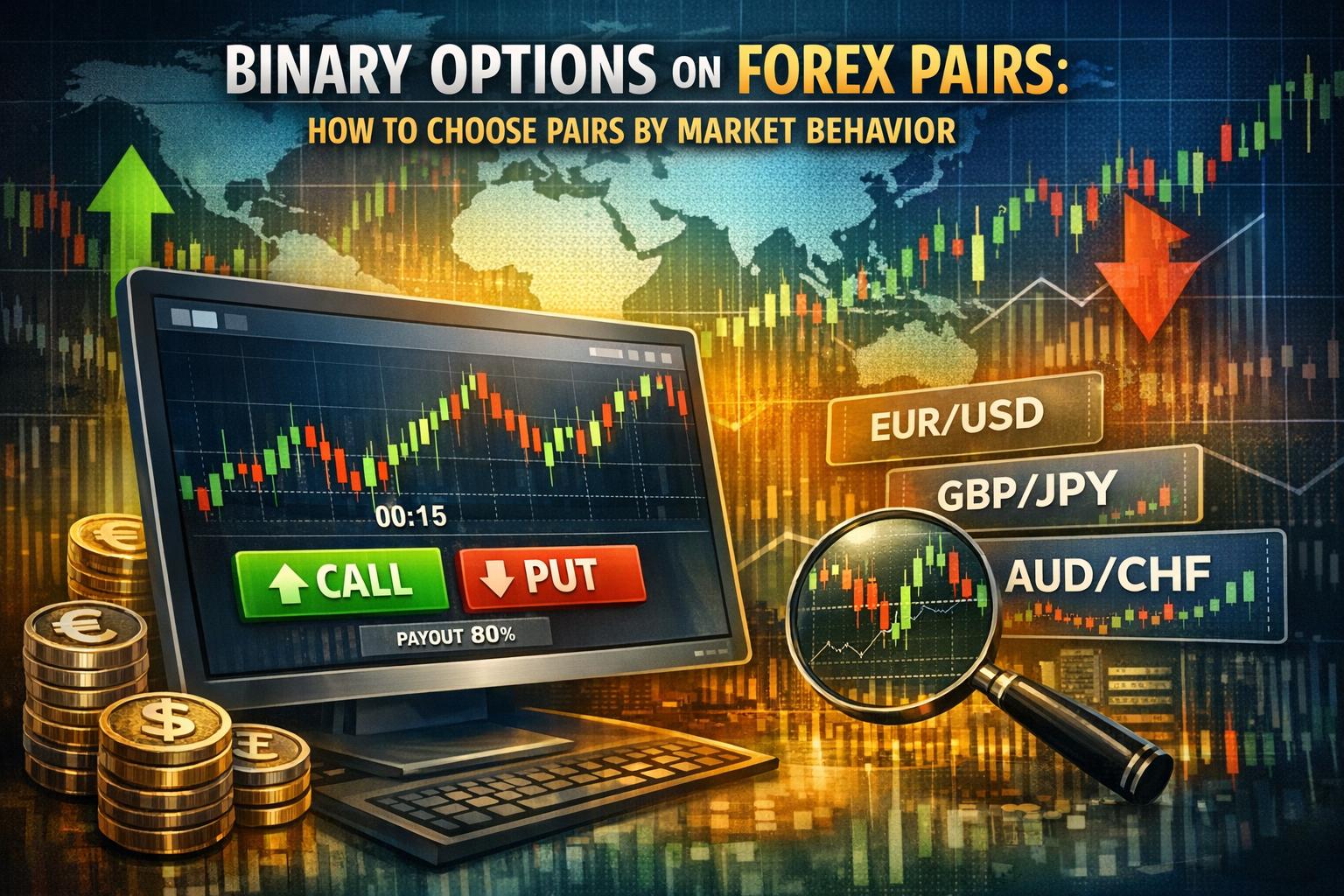
In forex binary options trading, the contract generally offers a fixed return percentage if the prediction is correct. Expiration periods may range from very short durations, such as one minute, to several hours or days. Before initiating a trade, the trader chooses the currency pair, selects the direction (commonly labeled “Call” for upward movement or “Put” for downward movement), determines the investment amount, and selects the expiration time.
The simplicity of execution does not eliminate the need for analysis. Price movement over short intervals can be highly sensitive to liquidity shifts, scheduled economic releases, and sudden market sentiment changes. Therefore, selecting appropriate forex pairs and trading sessions plays a central role in shaping potential outcomes.
Key Characteristics of Forex Pairs
Forex pairs are generally divided into three main categories: major pairs, minor pairs, and exotic pairs. Each category presents distinct liquidity conditions, volatility patterns, and sensitivity to global or regional developments. Understanding these differences helps traders align their binary options strategy with appropriate market conditions.
Major Pairs
Major pairs include the most actively traded currencies in the world, each paired with the US dollar. Examples include EUR/USD, GBP/USD, USD/JPY, and USD/CHF. These pairs typically offer the highest liquidity in the forex market. High liquidity often results in tighter spreads and smoother price action, reducing irregular price spikes that may complicate short-term predictions.
The movements of major pairs are strongly influenced by macroeconomic indicators from major economies such as the United States, the Eurozone, Japan, and the United Kingdom. Interest rate decisions by central banks, inflation reports, and employment data frequently cause measurable shifts in volatility. For binary options traders, this predictability surrounding scheduled announcements can provide structured opportunities, provided risk is managed appropriately.
Another important feature of major pairs is their responsiveness to global risk sentiment. During periods of economic uncertainty, currencies like the US dollar and Japanese yen may act as relative safe-haven assets, influencing directional bias.
Minor Pairs
Minor pairs, sometimes referred to as cross-currency pairs, exclude the US dollar. Examples include EUR/GBP, AUD/NZD, and CAD/CHF. These pairs generally exhibit lower overall trading volume compared to majors, which may result in slightly wider spreads and occasional periods of reduced liquidity.
Price movements in minor pairs are often driven by relative economic differences between the two respective countries rather than broad global developments alone. For instance, economic divergence between Australia and New Zealand can significantly influence AUD/NZD. Traders who closely track regional economic data may identify short-term directional opportunities in these pairs.
While volatility can sometimes exceed that of major pairs, minor pairs may also experience uneven trading activity outside their primary regional sessions. For binary options traders, session selection becomes particularly important when trading these instruments.
Exotic Pairs
Exotic pairs combine a major currency with the currency of a smaller or emerging economy. Examples include USD/SGD, USD/TRY, and EUR/ZAR. These pairs tend to have substantially lower liquidity and wider spreads. Price swings can be larger and more abrupt due to thinner order books and region-specific developments.
Exotic currencies are often influenced by local political decisions, commodity price fluctuations, and capital flow changes. For example, currencies of commodity-exporting nations may fluctuate significantly in response to global demand shifts. In binary options trading, these pronounced movements may appear attractive, yet unpredictability and execution risk are higher compared to major pairs.
Criteria for Choosing Forex Pairs by Market Behavior
Volatility
Volatility refers to the rate at which the price of a currency pair changes over time. In binary options trading, sufficient volatility is necessary because price movement must exceed the contract’s strike level before expiration. Low volatility environments may reduce the probability of decisive directional outcomes within short timeframes.
Volatility increases around major economic releases, central bank statements, and geopolitical events. Traders must assess whether heightened volatility aligns with their trading timeframe. Short expiration contracts may benefit from brief volatility spikes, while longer durations may require sustained directional momentum.
However, higher volatility also increases uncertainty. Rapid price fluctuations can reverse direction within seconds, particularly during news releases. A structured approach to timing and confirmation is essential when operating in highly volatile conditions.
Liquidity
Liquidity measures how actively a currency pair is traded. High liquidity generally results in smoother price patterns and reduced slippage between expected and actual pricing levels. Major pairs, especially during the London and New York sessions, exhibit consistently high liquidity.
For binary options traders, strong liquidity conditions often improve consistency of price feeds and reduce irregular price distortions. Trading less liquid pairs during off-peak sessions may produce erratic price action, complicating prediction accuracy.
Economic Indicators
Currency values respond to a broad range of economic indicators, including interest rates, employment data, inflation metrics, trade balances, and gross domestic product figures. Central bank policies have a particularly strong influence on exchange rates. When a central bank signals tightening monetary policy, its currency may appreciate due to expectations of higher returns on capital.
Binary options traders frequently monitor economic calendars to anticipate scheduled announcements. Timing trades just before or after significant releases requires careful evaluation. While announcements often generate volatility, markets may price in expectations beforehand, leading to counterintuitive reactions.
Trading Hours
The forex market operates continuously from Monday to Friday, spanning major financial centers in Asia, Europe, and North America. Activity level varies by session. The London session is widely recognized for its high trading volume, while the overlap between London and New York typically produces the most dynamic price movements.
Choosing the appropriate session can align market conditions with the trader’s strategy. Short-term binary options contracts often perform more consistently when executed during periods of higher liquidity and volatility. Conversely, quieter sessions may be more suitable for range-based strategies that rely on stable support and resistance levels.
Developing a Trading Strategy
A structured approach to binary options trading in forex requires integrating market analysis, risk control, and performance evaluation. Although binary options offer fixed outcomes, capital exposure management remains critical. Traders often determine position size relative to total account equity to prevent excessive drawdowns.
Clear entry criteria, defined expiration selection, and consistent evaluation metrics form the foundation of an effective strategy. Without defined parameters, performance assessment becomes unreliable. Historical testing of strategies using price charts can provide insight into how certain patterns perform under specific conditions.
Fundamental Analysis
Fundamental analysis focuses on evaluating macroeconomic conditions and political developments that influence currency valuation. Interest rate differentials between countries often play a central role. For example, if one central bank signals potential tightening while another maintains accommodative policies, the corresponding currency pair may exhibit directional bias.
Traders employing fundamental analysis in binary options typically concentrate on short-term reactions to high-impact events. Understanding consensus forecasts versus actual data outcomes helps interpret price responses. Market reaction is often determined not solely by the data itself but by how it compares to prior expectations.
Technical Analysis
Technical analysis involves examining historical price data to identify recurring patterns and statistical tendencies. Common tools include moving averages to identify trend direction, support and resistance levels to estimate potential reversal zones, and oscillators such as the Relative Strength Index (RSI) to gauge momentum or overbought and oversold conditions.
Chart patterns, including breakouts, consolidations, and retracements, can inform binary options decisions. For short expiration contracts, lower timeframe charts help identify immediate directional momentum. For longer expirations, higher timeframe trend alignment may improve probability consistency.
Combining technical signals with awareness of fundamental drivers may reduce the likelihood of trading against strong macroeconomic momentum. Alignment between broader trend direction and short-term technical triggers often contributes to more structured trade selection.
Risk Considerations and Regulatory Environment
Binary options carry inherent financial risk due to their fixed-return structure. The all-or-nothing payout model requires a probability edge greater than the break-even threshold determined by the platform’s payout ratio. If a platform offers a 75 percent return on successful trades, the trader must achieve a win rate sufficiently above 57 percent to maintain long-term profitability.
Regulatory frameworks vary by jurisdiction. Some countries impose strict oversight or prohibit retail binary options trading due to concerns regarding transparency and consumer protection. Traders should ensure that they operate within applicable legal frameworks and understand the contractual terms defined by their chosen broker.
Maintaining accurate performance records helps evaluate long-term expectancy and strategy effectiveness. Consistency in execution, disciplined capital allocation, and avoidance of impulsive decisions remain key operational principles.
Conclusion
Binary options in forex trading provide a structured mechanism for speculating on short-term currency movements. While the operational format is straightforward, success depends on comprehensive understanding of currency pair characteristics, volatility dynamics, liquidity conditions, and economic influences. Selecting appropriate forex pairs—whether major, minor, or exotic—requires evaluation of trading session timing and market context.
Integrating fundamental and technical analysis within a defined risk management framework supports informed decision-making. By emphasizing disciplined strategy development and continuous market assessment, traders can approach forex binary options with analytical structure rather than assumption-based speculation.
This article was last updated on: April 29, 2026