
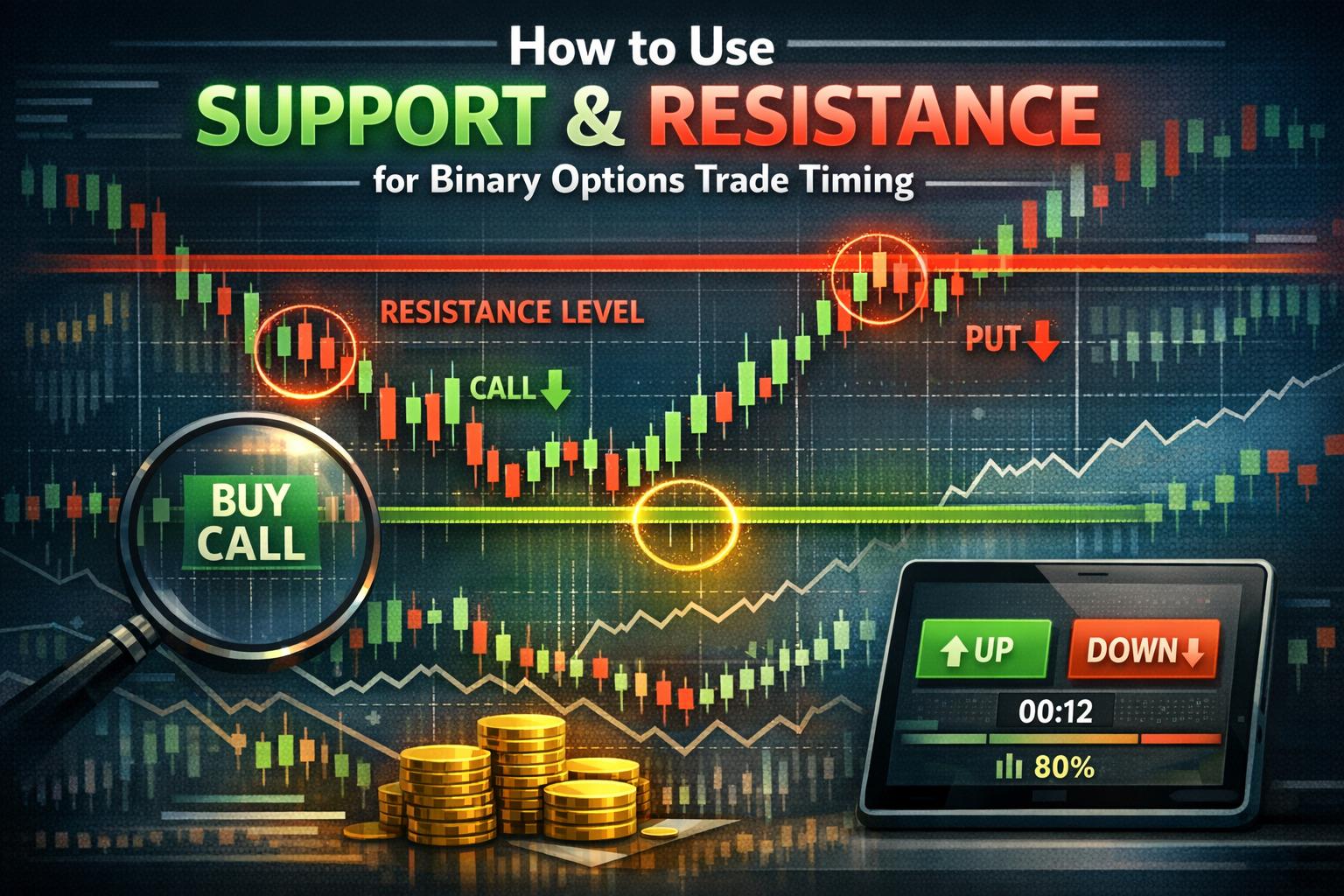
Understanding Support and Resistance
Support and resistance are foundational concepts in technical analysis, used to interpret price behavior and anticipate potential turning points in financial markets. These price levels represent areas on a chart where buying or selling pressure has historically been strong enough to influence direction. Traders across various markets, including stocks, forex, commodities, and indices, rely on these levels to structure trade plans and evaluate risk. In binary options trading, where outcomes depend on whether price finishes above or below a specific level at expiry, understanding support and resistance is particularly relevant.
At its core, technical analysis assumes that price reflects all available information and that historical price behavior often repeats under similar conditions. Support and resistance levels emerge from this repetition. When price approaches a previously tested level, market participants frequently react in comparable ways, creating identifiable patterns. Recognizing these patterns allows traders to frame probabilities rather than relying on speculation.
Defining Support and Resistance
Support refers to a price level at which downward movement tends to pause due to increased buying interest. When an asset approaches support, participants perceive it as relatively undervalued, prompting demand to rise. This increase in demand may prevent further decline, causing the price to stabilize or rebound. Support is not always a precise numerical value; more often, it is a zone where buying pressure consistently emerges.
Resistance represents the opposite dynamic. It is a level where rising prices encounter increased selling pressure. As price approaches resistance, some traders consider the asset relatively overvalued and choose to sell, increasing supply. If selling pressure outweighs demand, price may stall or reverse. Like support, resistance typically forms as a zone rather than a single exact point.
Support and resistance levels are formed through repeated interactions between buyers and sellers. When a level is tested multiple times without being broken, its perceived importance increases. Market memory plays a significant role in this process. Traders remember prior price reactions and often base new decisions on past outcomes, reinforcing these levels.
The Psychological Foundation
Support and resistance are closely tied to market psychology. Financial markets reflect aggregated human decisions, and recurring price levels often correspond to shared perceptions of value. For instance, if many traders previously bought at a certain level and saw price rise afterward, they may be inclined to buy again if price revisits that area. Similarly, traders who experienced declines after selling near a specific price may repeat that behavior when price returns to the same level.
Round numbers also frequently act as support or resistance because they hold psychological significance. Prices ending in whole numbers often attract increased attention, leading to concentration of pending orders around these levels. The result is additional buying or selling pressure when those prices are approached.
Why Support and Resistance Matter
Identifying support and resistance helps traders estimate potential price reactions. These levels provide structure to the market, allowing participants to define areas of interest rather than reacting to arbitrary fluctuations. Instead of predicting unlimited movement, traders can evaluate likely outcomes based on historical behavior at established price zones.
In binary options trading, accuracy in timing is essential because each trade has a defined expiration. If a trader anticipates that price will bounce from support within a specific timeframe, this assumption can guide the choice of expiry and direction. Similarly, awareness of nearby resistance can prevent entering trades that lack sufficient room for price movement before expiration.
Beyond trade direction, support and resistance assist with risk assessment. Even though binary options involve fixed risk and reward, understanding how far price may reasonably travel within a given period supports better strategy planning. Traders are less likely to place positions randomly when they operate within a structured analytical framework.
Using Support and Resistance in Binary Options Trading
Binary options require traders to predict whether the price of an asset will be above or below a specified level at a predetermined time. Because of this limited outcome structure, locating significant price levels becomes central to decision-making. Support and resistance serve as reference points for estimating short-term direction and potential reversals.
In ranging markets, where price moves between defined upper and lower boundaries, support and resistance can provide repeated trading opportunities. Price often oscillates between these zones before breaking into a new trend. Recognizing this behavior allows traders to anticipate movement within established boundaries.
In trending markets, support and resistance may shift over time. In an uptrend, previous resistance can transform into support once broken. In a downtrend, former support can become resistance. This concept, sometimes described as role reversal, reflects a shift in market perception and order flow.
Entry and Exit Considerations
When price approaches a well-established support level, traders may interpret this as a potential opportunity to anticipate upward movement. In binary options, this could translate into considering a position that benefits if price finishes above the current level at expiration. The rationale is that demand at support may lead to stabilization or modest appreciation.
Similarly, when price nears a recognized resistance zone, traders may evaluate whether selling pressure is likely to increase. A position anticipating lower closing prices can be structured accordingly. However, timing remains a critical factor. Entering too early, before confirmation of rejection, may reduce the probability of a favorable outcome.
Confirmation techniques often involve observing candlestick behavior, volume changes, or momentum indicators near these levels. A strong rejection candle near support, for example, provides additional information suggesting that buyers are active. While not guaranteeing success, such confirmation refines the decision-making process.
Breakouts and False Breakouts
Support and resistance levels do not hold indefinitely. When price breaks decisively beyond these zones, it may signal the beginning of a new directional phase. In binary options, traders sometimes attempt to capitalize on breakouts by anticipating continuation beyond the violated level.
However, not all breakouts are sustained. False breakouts occur when price temporarily moves beyond support or resistance but quickly reverses back into the prior range. These movements can result from short-term liquidity imbalances, news events, or stop-loss triggering. Acting on unconfirmed breakouts increases exposure to unfavorable outcomes.
To reduce the risk of misinterpretation, traders often wait for additional confirmation, such as sustained closes beyond the level or increased volume supporting the move. The duration for confirmation depends on the timeframe being analyzed and the expiry period of the binary option.
Timeframes and Their Influence
Support and resistance exist across multiple timeframes. A level visible on a daily chart may carry more weight than one observed on a five-minute chart due to the greater number of market participants involved in its formation. In binary options trading, the chosen timeframe should align with the trade’s expiry duration.
Short-term traders may focus on intraday support and resistance derived from hourly or shorter charts. These levels can guide trades expiring within minutes or hours. Longer-duration binary options may benefit from daily or weekly levels, which represent broader market consensus.
Aligning analysis timeframe with trade duration reduces inconsistency. For instance, relying solely on a daily support level for a very short expiration may overlook short-term volatility that impacts the outcome before the broader trend resumes.
Techniques to Identify Support and Resistance Levels
Identifying reliable support and resistance requires systematic chart analysis. Multiple methods can be applied, and combining them can strengthen confidence in identified zones.
Historical Price Observation
The most direct technique involves examining past price movements to locate areas where reversals or consolidations repeatedly occurred. When price has previously reversed several times near a certain level, that area may represent strong buying or selling interest. These recurring turning points form the basis of horizontal support and resistance lines.
Observing how price behaves upon each retest adds insight. If reactions become weaker over time, it may indicate that the level is losing relevance. Conversely, strong and consistent rejections can signal continued significance.
Chart Patterns
Recognizable chart formations frequently highlight support and resistance. Patterns such as double tops and double bottoms illustrate repeated price rejection at similar levels. In a double top, price fails to surpass a resistance level twice, suggesting persistent selling pressure. In a double bottom, repeated support tests reflect sustained buying interest.
The head-and-shoulders pattern also centers around a defined support area known as the neckline. A break of this neckline often signals a shift in market direction. Identifying such formations helps contextualize support and resistance within broader structural developments rather than viewing them as isolated lines.
Moving Averages
Moving averages provide dynamic support and resistance zones that adjust as price evolves. In trending markets, shorter-period moving averages may act as near-term support during pullbacks in an uptrend or as resistance during retracements in a downtrend. Longer-period moving averages often represent broader equilibrium levels that many traders monitor.
When price repeatedly reacts near a moving average, it reinforces the significance of that average as a dynamic barrier. Integrating moving averages with horizontal levels can help determine whether multiple signals converge at a single price zone.
Trendlines
Drawing trendlines by connecting sequential higher lows in an uptrend or lower highs in a downtrend provides a visual representation of directional support or resistance. These diagonal levels differ from horizontal lines in that they reflect the ongoing progression of a trend.
Trendline breaks may indicate weakening momentum or potential reversal. In binary options trading, anticipating whether price will hold above or below a trendline at expiry can form the basis of a structured trade hypothesis.
Price Channels and Ranges
Channels form when price fluctuates between parallel support and resistance boundaries. These boundaries help define trading ranges and can highlight repeated oscillations. When price approaches the upper boundary, resistance considerations arise; near the lower boundary, support becomes relevant.
Watching for contraction or expansion within channels can offer insight into potential breakouts. Narrowing volatility may precede significant directional movement, especially when combined with increasing volume or fundamental catalysts.
Integrating Support and Resistance with Other Indicators
While support and resistance offer valuable structural guidance, relying solely on them may limit analytical depth. Combining them with complementary indicators improves contextual understanding. Momentum oscillators, such as those measuring overbought or oversold conditions, can highlight whether a level is likely to hold or fail. Volume analysis can reveal participation strength at key price zones.
For example, if price approaches resistance while momentum weakens and volume declines, the probability of rejection may increase. Alternatively, strong volume accompanying a breakout could suggest sustained continuation. Integrating multiple tools does not eliminate uncertainty but helps refine probability assessments.
In binary options trading, where each position has a fixed outcome, incremental improvements in probability can influence long-term results. Consistency in applying a combined analytical framework enhances discipline and reduces reliance on impulsive decisions.
Practical Considerations and Limitations
Support and resistance are interpretive tools rather than precise predictors. Markets are influenced by economic data, geopolitical events, and shifts in investor sentiment that may override technical levels. Sudden volatility can disrupt previously respected zones, especially during major announcements.
It is also important to recognize that drawing support and resistance involves subjective judgment. Different traders may identify slightly different zones depending on timeframe selection and chart scaling. Maintaining consistency in methodology helps reduce confusion and improves repeatability.
Overcomplicating charts with excessive lines may obscure clarity. Focusing on the most evident and frequently tested levels supports better analysis. Quality often outweighs quantity in identifying meaningful price zones.
Conclusion
Support and resistance provide a structured method for interpreting price behavior by identifying areas where buying or selling interest has historically influenced direction. These levels reflect collective market psychology and recurring interaction between supply and demand. In binary options trading, where timing and directional accuracy are central, understanding these concepts enhances strategic planning.
By examining historical price reactions, chart patterns, moving averages, and trendlines, traders can identify zones that may guide entry decisions and refine trade expectations. Awareness of breakouts and false breakouts further reduces exposure to misinterpretation.
Although support and resistance are widely used and respected tools, they function most effectively when integrated with complementary analysis and consistent risk management. Through disciplined application, traders can use these levels to create a more systematic and probability-based approach to binary options trading.
This article was last updated on: May 5, 2026