
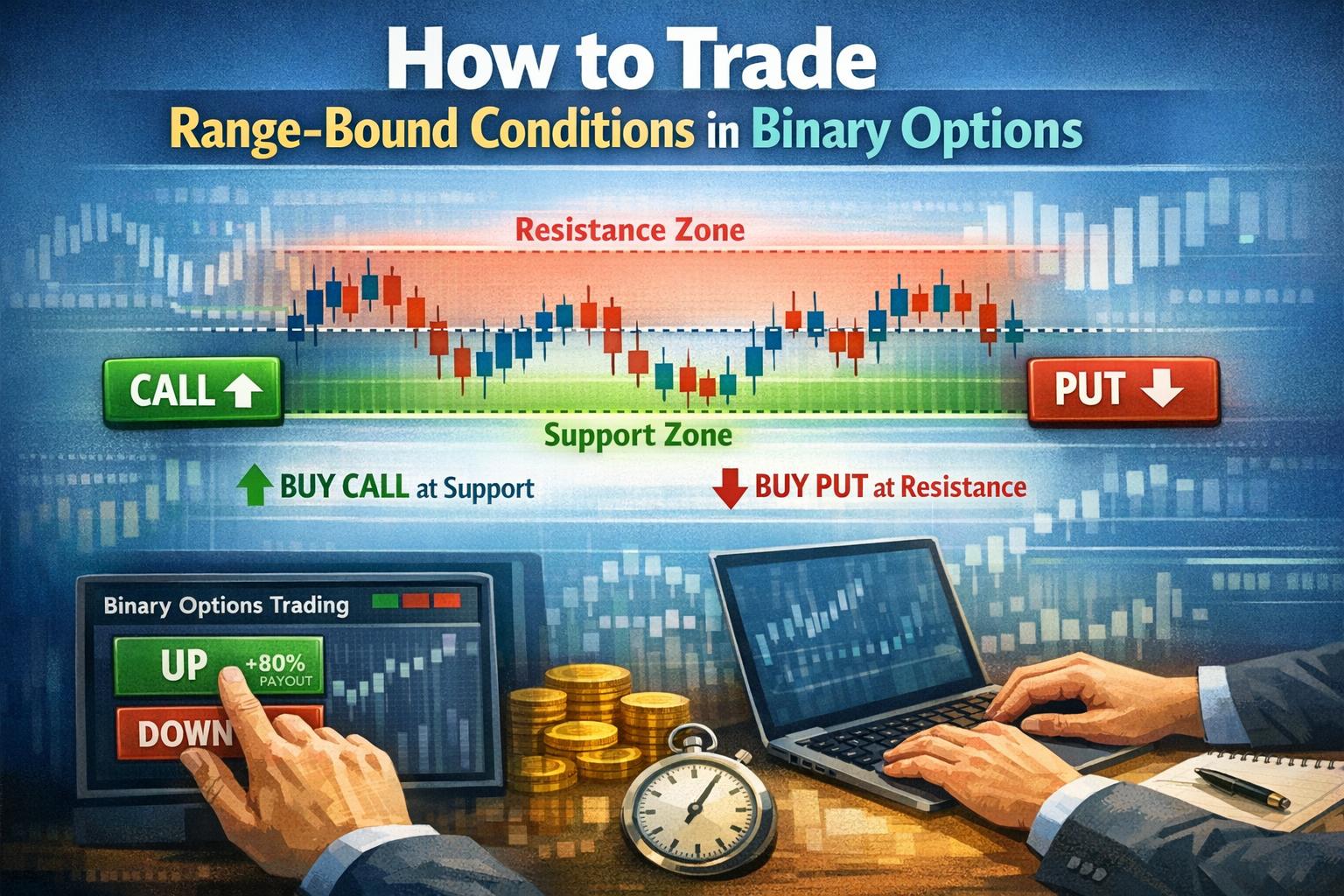
Trading range-bound conditions in binary options can provide structured opportunities for traders who understand how prices behave when markets lack a clear directional trend. In a range-bound environment, asset prices fluctuate between identifiable upper and lower limits, creating recurring price reactions at similar levels. For binary options traders, whose returns depend on predicting whether certain price conditions will be met at expiration, these oscillations can offer repeatable setups when properly analyzed. A disciplined approach built on technical observation, probability assessment, and risk management is necessary to use such market structures effectively.
Understanding Range-Bound Markets
A range-bound market forms when supply and demand reach a temporary equilibrium. Instead of producing sustained upward or downward momentum, the price cycles between zones of buying and selling pressure. These zones, commonly known as support and resistance, contain most of the price activity. During this period, market participants generally agree on a broad valuation area, resulting in limited directional conviction.
Range-bound conditions may appear after a strong trend has concluded or during periods of reduced macroeconomic influence. Lower trading volume, absence of significant news catalysts, or market consolidation after volatility can contribute to such environments. The absence of dominant buyers or sellers creates repeated reversals within predictable boundaries.
For binary options traders, identifying whether the market is trending or consolidating is essential. Trend-following strategies often underperform in sideways conditions because breakouts fail to sustain momentum. Conversely, strategies built on price reversals or price containment function more effectively when the market repeatedly respects established boundaries.
Market Psychology in Consolidation Phases
Understanding the psychology behind consolidation helps clarify why range-bound markets occur. After pronounced price movements, institutional and retail participants may reduce exposure while reassessing valuation. Buyers who entered earlier take profits near perceived highs, while sellers close positions near perceived lows. This cyclical behavior reinforces horizontal price levels.
As price approaches resistance, traders anticipate potential reversal due to prior selling activity. When price declines toward support, market participants expect renewed buying interest. These shared expectations generate self-reinforcing patterns. In binary options trading, recognizing this behavioral repetition enables traders to anticipate short-term reactions at established boundaries.
Identifying Support and Resistance Levels
Support refers to a price level at which buying interest has historically been strong enough to halt downward movement. Resistance refers to a level where selling activity has prevented further upward progress. These levels are rarely exact prices; rather, they are zones within which the market has previously reversed.
Accurate identification of these areas forms the foundation of any range-based strategy. Traders commonly examine historical charts to locate multiple price rejections at similar levels. The more frequently price reacts at a certain zone without breaking through, the stronger that support or resistance is considered.
Using Chart Analysis to Define Boundaries
Horizontal price levels are the most direct way to mark support and resistance. Traders examine swing highs and swing lows, drawing lines that capture recurring turning points. Ideally, a range should display at least two clear touches on both the upper and lower boundaries to validate its structure.
Timeframe selection also plays a role. A range visible on a higher timeframe typically carries more significance than one on a short-term chart. For instance, a consolidation pattern on a four-hour chart may offer more reliable boundaries than a similar pattern on a five-minute chart. Binary options traders must align option expiration times with the timeframe being analyzed to maintain consistency.
Technical Indicators in Range Identification
Technical indicators can support visual chart analysis. Oscillators such as the Relative Strength Index (RSI) and Stochastic Oscillator are particularly useful in range-bound markets. These tools measure overbought and oversold conditions, helping traders anticipate potential reversals near resistance and support.
When an oscillator signals overbought conditions near a well-defined resistance zone, the probability of downward reaction increases. Conversely, oversold readings near support strengthen the case for upward price reaction. However, indicators should confirm price structure rather than replace it. Price action itself remains the primary source of information.
Trading Strategies in Range-Bound Conditions
Once a range is clearly identified, traders can apply strategies designed specifically for non-trending behavior. The key objective is to anticipate either containment within the range or predictable rejection from its boundaries. In binary options trading, this involves selecting appropriate contract types and expiration times.
Boundary Options
Boundary options, sometimes called range options, are particularly aligned with consolidation markets. In this contract type, the trader predicts whether the asset’s price will remain within specified upper and lower levels until expiry. If the price stays inside the defined area, the option settles in profit.
This approach requires careful evaluation of the range’s width and historical price stability. A narrow range with frequent false breakouts may increase risk, while a clearly respected horizontal channel with multiple contained fluctuations may improve probability. Traders must also account for potential volatility events that could disrupt equilibrium before expiration.
Expiration timing is critical when trading boundary options. The expiration period should match the timeframe on which the range is validated. Short-term boundary contracts on a higher timeframe range may expose traders to random volatility, while excessively long expirations may increase exposure to unexpected breakouts.
Reversal-Based Call and Put Options
Another method involves purchasing standard call and put binary options at the edges of the range. When price approaches support, traders may enter a call option anticipating upward reversal. Near resistance, a put option may be selected in expectation of downward reaction.
This technique requires patience and confirmation. Entering prematurely before price reaches the boundary reduces the statistical advantage. Traders often wait for additional confirmation signals, such as candlestick rejection patterns or oscillator divergence, before committing capital.
The Straddle Strategy
The straddle strategy in binary options differs from its traditional options counterpart but retains the principle of engaging both directional possibilities. In range-bound markets, a modified straddle approach may involve simultaneously preparing for either a breakout or continuation within the range.
For instance, if price compresses tightly near the center of the range, volatility expansion may follow. A trader may structure positions to benefit from movement in either direction, depending on broker offerings. This strategy requires careful cost assessment, as entering multiple contracts increases capital exposure.
Breakouts Versus False Breakouts
Although range-bound markets are defined by containment, they eventually transition into trends. Distinguishing genuine breakouts from temporary false ones is a central challenge. False breakouts occur when price briefly exceeds support or resistance before returning inside the range.
Volume spikes, strong momentum candles, or retests of a broken boundary can help validate a legitimate breakout. In binary options trading, entering immediately after a breakout without confirmation may expose traders to whipsaw movements. Waiting for a retest of the broken level as new support or resistance may improve trade quality.
Risk Management in Range Trading
Risk management remains central to sustainability in binary options trading. Because payouts and losses are predefined, traders must determine position sizing carefully. Allocating a consistent percentage of trading capital per trade reduces the impact of consecutive losses.
Range-bound trading may create the illusion of predictability due to repeated patterns. However, unexpected market events can quickly invalidate established boundaries. Scheduled economic announcements, geopolitical developments, or sudden liquidity shifts can trigger abrupt volatility expansions.
Maintaining a balanced approach involves limiting exposure, avoiding overtrading within the same range, and recognizing when market conditions begin transitioning away from consolidation. If price starts forming higher highs and higher lows, or lower lows and lower highs, the range structure may be weakening.
Timing and Expiration Considerations
Binary options differ from other financial instruments in that outcome depends on price at expiration rather than magnitude of movement. Therefore, selecting the correct expiration time is as important as predicting direction. In range-bound conditions, expiration should allow sufficient time for anticipated reversals while minimizing exposure to unexpected breakouts.
Short expirations may capitalize on frequent oscillations within the range but carry higher sensitivity to random price noise. Longer durations may accommodate gradual movement toward the opposite boundary but increase uncertainty. Matching expiration to both volatility and chart timeframe improves alignment between analysis and execution.
Adapting to Changing Market Conditions
Markets are dynamic. A range that has held for days or weeks can dissolve quickly when new information enters the market. Continuous monitoring of price behavior ensures that traders do not rely on outdated assumptions. Signs of weakening range integrity include shrinking pullbacks, repeated testing of one boundary without strong rejection, and rising volatility.
When such signals emerge, traders may reduce range-based exposure and reassess overall structure. Flexibility is essential, as persisting with range strategies during emerging trends often leads to repeated losses.
Performance Evaluation and Continuous Improvement
Systematic evaluation strengthens trading consistency. Recording entry rationale, boundary identification method, expiration selection, and trade outcome allows traders to identify recurring strengths and weaknesses. Over time, data-driven insights replace subjective impressions.
Analyzing performance across different assets may also reveal which instruments exhibit more stable range behavior. Certain currency pairs, commodities, or indices may consolidate more frequently than others depending on macroeconomic conditions. Selecting appropriate markets enhances probability alignment with strategy design.
Conclusion
Trading range-bound conditions in binary options involves recognizing equilibrium phases where price oscillates between defined support and resistance zones. By combining structured chart analysis with confirmation tools and disciplined risk management, traders can develop approaches suited to these non-trending environments. Careful attention to expiration timing, volatility context, and boundary validation supports consistency. Although consolidation markets provide recurring patterns, they remain subject to unexpected change, requiring continuous evaluation and adaptability. Through systematic observation and measured execution, traders can use range-bound structures as part of a broader, balanced trading framework.
This article was last updated on: May 18, 2026