
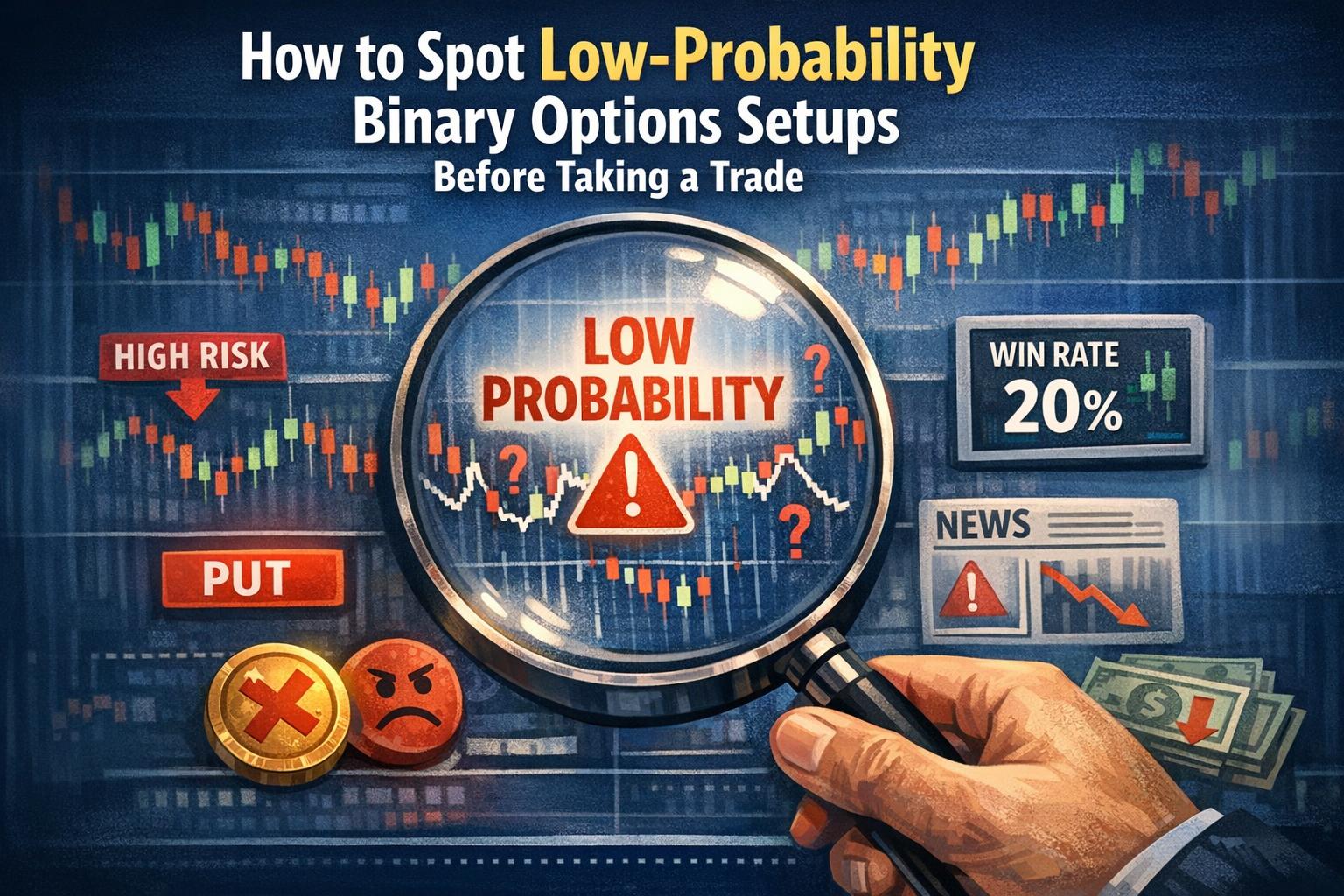
Understanding Binary Options
Binary options are a type of financial instrument that allow traders to speculate on the price movement of an underlying asset within a specified time frame. The defining characteristic of these instruments is their fixed outcome structure. At expiration, the option either settles in-the-money, resulting in a predetermined payout, or out-of-the-money, resulting in the loss of the invested amount. Because there are only two possible outcomes, the instrument is described as “binary.”
Underlying assets available for binary options trading commonly include currencies, commodities, stock indices, and individual equities. Traders do not purchase the asset itself. Instead, they enter into a contract based on whether the asset’s price will be above or below a specific level at a defined expiration time. This structure simplifies the payoff profile but does not reduce the underlying complexity of market behavior.
The simplicity of the payoff mechanism has contributed to the popularity of binary options among retail traders. However, the apparent clarity of the outcome can obscure the importance of probability, timing, and disciplined analysis. Assessing whether a setup offers a reasonable statistical edge is central to sustainable participation in this market.
Pricing Structure and Mechanics
To understand how low-probability setups arise, it is essential to examine how binary options are priced. Each contract includes a strike price and an expiration time. The strike price represents the level against which the asset’s value will be compared at expiration. The expiration time may range from minutes to several months, depending on the broker and product specifications.
The payout is typically fixed as a percentage of the investment, often ranging from 60% to 95% if the trade is successful. If the trade fails, most standard contracts result in a total loss of the premium paid. This asymmetric payoff structure means that even if a trader’s win rate is slightly above 50%, profitability is not guaranteed. The relationship between win rate and payout percentage must be evaluated carefully to determine the breakeven threshold.
For example, if a binary option pays 80% on winning trades and the full premium is lost on unsuccessful trades, the trader must achieve a win rate greater than approximately 55% to break even. This requirement highlights the importance of filtering out low-probability setups and focusing only on trades with a measurable statistical advantage.
Identifying Low-Probability Setups
Binary options trading can present elevated risk when traders enter positions without sufficient analytical support. Low-probability setups are scenarios in which the likelihood of the predicted outcome occurring is limited relative to the required breakeven probability. Recognizing these situations demands a structured evaluation process.
Market Conditions
An essential component of probability assessment is understanding prevailing market conditions. Markets do not behave uniformly at all times. They may exhibit trending behavior, range-bound consolidation, or heightened volatility driven by economic announcements or geopolitical developments. Each environment influences the reliability of price signals.
In highly volatile conditions, rapid price fluctuations can increase uncertainty, particularly for short-term expiration contracts. Sudden price spikes may cause positions to settle out-of-the-money even if the broader analysis was directionally accurate. Conversely, in low-volatility environments, price stagnation can undermine breakout-based strategies.
Monitoring scheduled economic releases, central bank communications, and earnings reports is necessary when trading assets sensitive to such events. Entering positions immediately before major announcements often creates low-probability setups because price movement may not follow established technical patterns. A structured approach incorporates both current volatility metrics and the broader macroeconomic context.
Technical Indicators
Technical analysis assists in estimating the probability of future price movement based on historical data. Common tools include Moving Averages, Relative Strength Index (RSI), and Bollinger Bands. Each indicator captures a different dimension of price behavior, such as trend direction, momentum, or volatility.
Moving Averages smooth historical price data to highlight underlying trends. When short-term averages cross above long-term averages, the market may indicate upward momentum. However, in ranging markets, frequent crossovers can generate conflicting signals. Acting on these signals without confirming broader market structure can create low-probability entries.
The RSI measures momentum and identifies overbought or oversold conditions. While extreme readings may precede reversals, they can persist for extended periods during strong trends. Entering a reversal-based binary option solely because RSI indicates overbought conditions may produce poor results if the prevailing trend remains intact.
Bollinger Bands provide a volatility-based framework. When prices approach the outer bands, traders may anticipate reversion or breakout scenarios. Distinguishing between these two possibilities requires additional confirmation. A setup that relies on a single volatility signal without trend confirmation may have a limited probability of success.
Low-probability setups frequently occur when indicators provide mixed or contradictory information. For example, a bullish Moving Average crossover combined with declining momentum readings from RSI suggests uncertainty. In such cases, refraining from trading may preserve capital and maintain consistency in strategy execution.
Reputable Brokers and Data Quality
The quality of data and execution provided by a broker significantly affects trading outcomes. Binary options pricing depends on accurate underlying market feeds and transparent contract specifications. Incomplete charting tools or delayed data can distort analysis, leading to entries based on inaccurate assumptions.
Reputable brokers typically provide comprehensive charting platforms, multiple time frame analysis, and clear disclosure of payout structures. Access to historical data is also critical for evaluating the past performance of specific strategies. Trading without reliable analytical resources increases the likelihood of misjudging probability.
Additionally, transparent order execution policies help ensure that the quoted price reflects real market conditions. Slippage or inconsistent pricing may alter the effective strike level, thereby changing the statistical expectancy of a trade. Selecting a regulated and established provider contributes to maintaining analytical consistency.
Risk-Reward Ratio
Assessing the risk-reward ratio is central to filtering out low-probability trades. Because binary options offer fixed returns, traders must calculate whether the expected payout justifies the probability of success required. A trade that offers a 70% return but requires a 60% win rate to remain profitable may not align with the trader’s historical performance metrics.
Evaluating risk-reward involves more than reviewing the payout percentage. It also requires estimating the realistic probability of the projected outcome occurring within the defined expiration window. Shorter expiration times typically demand more precise timing, whereas longer durations may allow for broader price movement but expose the position to more intervening factors.
If the statistical edge is marginal or uncertain, the setup may not warrant entry. Declining trades that do not meet predefined probability thresholds reduces overall variance and supports long-term capital preservation.
Avoiding Common Pitfalls
Overtrading
Overtrading is a frequent contributor to exposure to low-probability setups. The availability of short-term contracts can encourage frequent participation, particularly during periods of minimal price movement. However, increased trade frequency does not inherently improve profitability. Instead, it often amplifies transaction exposure and compounds small analytical errors.
A structured trading plan establishes criteria for entry, position sizing, and daily or weekly trade limits. By restricting activity to setups that meet defined standards, traders can reduce the impact of impulsive decisions. Maintaining a trading journal also assists in identifying patterns of excessive activity and evaluating their outcomes objectively.
Emotional Decision-Making
Decision-making influenced primarily by short-term outcomes can compromise analytical discipline. After a series of losses, traders may attempt to recover capital by entering marginal setups. Similarly, consecutive wins can create overconfidence, leading to reduced scrutiny of trade conditions.
Maintaining consistency involves adhering to predefined rules regardless of recent performance. Risk allocation per trade should remain stable relative to account size, and deviation from established criteria should be avoided. Structured evaluation reduces variability associated with subjective judgment.
Adopting a Strategic Approach
Developing a strategic framework is essential for managing probability effectively. A well-defined methodology integrates market selection, time frame analysis, confirmation signals, and exit criteria. Rather than reacting to isolated price movements, the trader operates within a cohesive decision model.
Backtesting historical data can provide insight into how a strategy performs under various market conditions. While past performance does not guarantee future results, systematic review helps identify recurring strengths and vulnerabilities. Metrics such as win rate, average payout, and drawdown periods contribute to understanding statistical expectancy.
Continuous evaluation is also necessary. Market behavior evolves over time due to shifts in liquidity, regulation, and macroeconomic forces. A strategy that performs adequately in trending conditions may underperform during periods of consolidation. Adapting parameters while preserving core principles enhances resilience.
Risk management forms the foundation of a strategic approach. Limiting exposure per trade to a small percentage of total capital reduces the effect of inevitable losses. Since binary options provide all-or-nothing outcomes, protecting capital during sequences of unfavorable results is especially important. Consistency in position sizing supports long-term sustainability.
Regulatory and Structural Considerations
Binary options trading is subject to varying regulatory standards across jurisdictions. In some regions, the product is restricted or prohibited for retail investors due to concerns regarding transparency and investor protection. Understanding the legal framework applicable to one’s location is necessary before engaging in trading activity.
The structural design of certain binary products may differ. Variants such as one-touch, no-touch, and range options introduce additional layers of conditionality. Each format requires separate probability assessment because payout conditions vary. Evaluating contract specifications in detail reduces the likelihood of misunderstandings that could affect expected returns.
Conclusion
Binary options present a simplified payoff structure, but effective participation requires a comprehensive understanding of probability, market dynamics, and disciplined execution. Low-probability setups often arise from inadequate assessment of market conditions, conflicting technical signals, imbalanced risk-reward ratios, or inconsistent risk management practices.
By integrating technical analysis, awareness of macroeconomic influences, reliable brokerage infrastructure, and structured planning, traders can better evaluate whether a potential position offers sufficient statistical merit. Avoiding overtrading and maintaining consistent decision-making criteria further contributes to reducing exposure to marginal setups.
Long-term performance in binary options trading depends less on individual outcomes and more on the consistent application of a method that prioritizes probability and capital preservation. Through ongoing analysis and disciplined execution, traders can refine their ability to distinguish between high-quality opportunities and low-probability scenarios.
This article was last updated on: May 30, 2026