
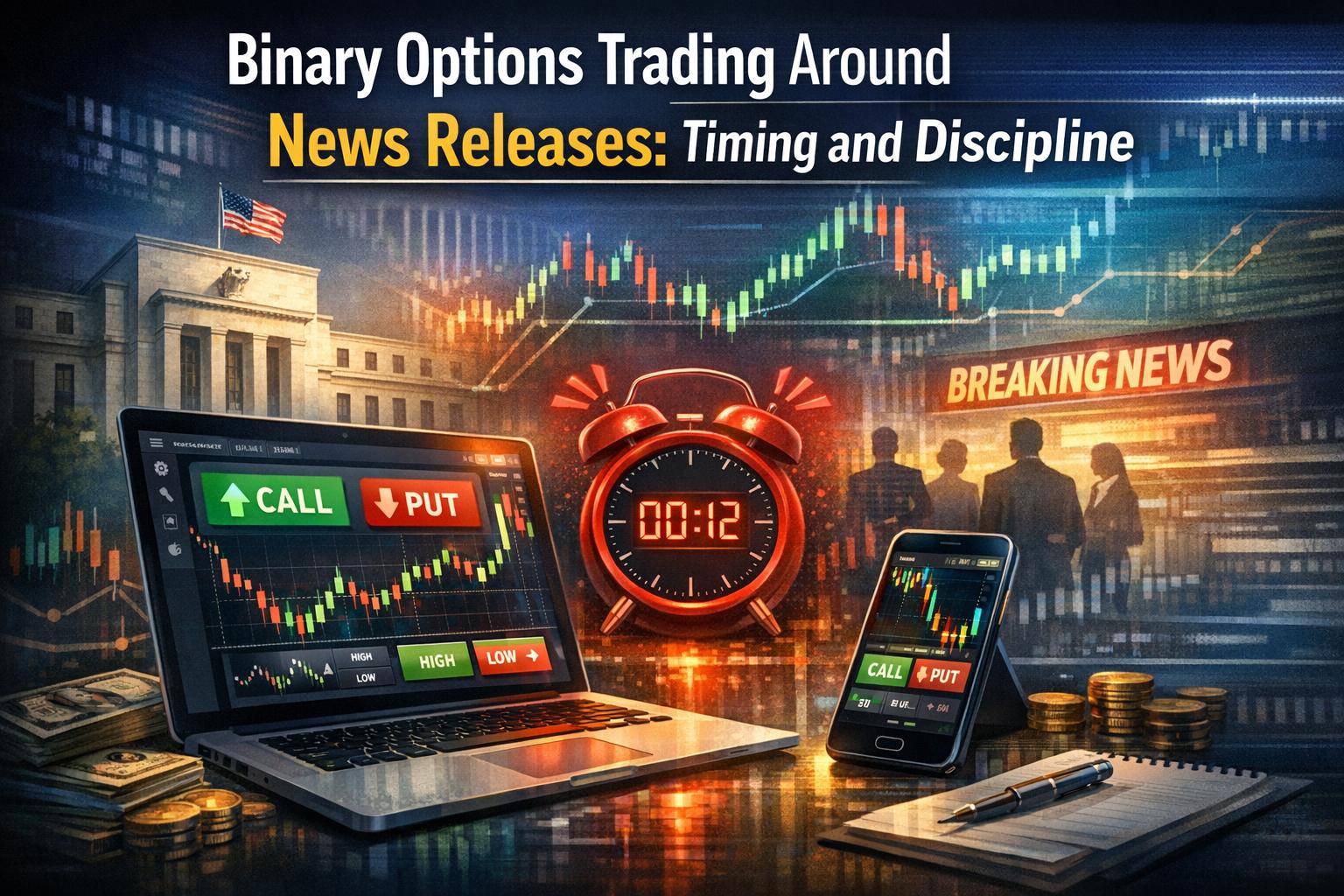
Understanding Binary Options Trading
Binary options trading is a financial instrument based on a simple proposition: whether the price of a selected asset will be above or below a specified level at a defined expiration time. The assets underlying binary options commonly include foreign exchange currency pairs, publicly traded stocks, market indices, and commodities such as gold or crude oil. Unlike traditional trading, where profit or loss depends on the magnitude of price change, binary options offer a fixed return if the trader’s forecast is correct and a predetermined loss if it is not.
At its core, a binary option has two possible outcomes. A trader selects either a call option, anticipating that the asset’s price will rise above the current level, or a put option, anticipating that the price will fall below it. If the prediction is accurate when the option expires, the trader receives a fixed payout. If it is inaccurate, the original investment in that trade is forfeited. This all-or-nothing structure simplifies the calculation of potential profit and risk before entering a trade.
Expiration times can range from very short intervals, such as one minute, to longer durations extending over several hours or days. The short-term nature of many binary options contracts makes them sensitive to immediate market catalysts. As a result, traders often focus on events and data releases that can influence prices within tight time frames.
While the structure appears straightforward, binary options trading requires analysis of price behavior, understanding of market drivers, and disciplined decision-making. Because the potential return and risk are known in advance, the primary challenge is not calculating position size after price movement but rather assessing probability prior to entry.
The Impact of News Releases
Financial markets respond continuously to new information. Among the most influential sources of information are scheduled economic news releases issued by governments, central banks, and statistical agencies. These announcements provide insight into economic performance, inflation trends, employment conditions, monetary policy, and other macroeconomic indicators. As new data becomes available, market participants adjust their expectations, and prices often respond immediately.
Examples of major news releases include employment reports such as non-farm payrolls in the United States, inflation measures such as the Consumer Price Index, gross domestic product figures, central bank interest rate decisions, and official statements from monetary authorities. The release of such information can generate rapid price fluctuations across currency pairs, stock indices, and commodity markets.
In the context of binary options trading, this volatility presents both opportunity and risk. Because binary contracts frequently have short expiration periods, even modest price fluctuations triggered by news can determine the outcome of a trade. If a trader correctly anticipates how the market will interpret a data release, the fixed payout structure can produce consistent returns. However, if the market reaction is unexpected or highly erratic, losses can occur just as quickly.
It is important to note that markets do not respond solely to the data itself, but rather to the difference between actual results and prior expectations. Financial analysts typically produce forecasts ahead of major announcements. When released figures deviate significantly from these forecasts, volatility tends to increase. Traders who understand this dynamic can better assess potential trading scenarios around news events.
Timing Is Crucial
The role of timing in binary options trading becomes particularly significant during periods of scheduled news announcements. Price movements immediately before and after a release can be sharp and unpredictable. Liquidity conditions may shift rapidly, and bid-ask spreads can widen in response to sudden changes in supply and demand. These factors can influence the execution and outcome of short-duration trades.
Monitoring an economic calendar is an essential part of preparation. Such calendars outline the date, time, and expected impact level of forthcoming reports. By reviewing this information in advance, traders can determine whether to participate in the potential volatility or temporarily avoid trading to reduce uncertainty. Awareness of time zones and market sessions is also necessary to prevent missed releases.
Execution speed is another component of timing. Because price adjustments often occur within seconds after a major announcement, delays in decision-making can alter trade outcomes. Some traders choose to enter positions shortly before the release, relying on analysis and expectations. Others prefer to wait until initial volatility subsides, observing the direction of price momentum before entering a trade. Each approach involves trade-offs between potential reward and exposure to rapid fluctuations.
Short-term expiration contracts amplify the significance of timing. A price movement that occurs several minutes after entry may determine whether a one-minute option finishes in or out of the money. Therefore, understanding not only the likely direction of the market but also the likely speed and duration of the move is an important aspect of strategy formulation.
Developing Timing Strategies
Traders who focus on news-based binary options often refine specific methods adapted to different market conditions. One widely applied approach involves taking a position prior to the news release based on anticipated outcomes. This pre-release strategy assumes that the trader’s analysis of forecasts, economic trends, or market sentiment provides a reliable indication of the probable market reaction. While this method allows participation in the immediate volatility following the announcement, it also exposes the trader to the risk that the actual data will contradict expectations.
An alternative method is the post-release strategy, which emphasizes patience. Instead of entering immediately, the trader waits for the initial reaction to unfold. In many cases, the first price movement reflects automated trading systems or short-term speculation, and subsequent price action may stabilize into a clearer directional move. By waiting for confirmation through price patterns or short-term support and resistance levels, traders attempt to reduce exposure to erratic fluctuations.
Another approach is sometimes referred to as a straddle strategy. In this context, a trader places both a call and a put option around the time of a significant announcement. The objective is to benefit from substantial volatility regardless of direction. If the price moves sharply in one direction, one option may expire profitably while the other expires at a loss. The viability of this method depends on payout ratios, asset volatility, and transaction costs. Careful calculation is required to determine whether the potential gain from one successful contract can compensate for the cost of the unsuccessful one.
Each timing strategy requires evaluation of historical price behavior during comparable events. By reviewing past market responses to similar data releases, traders can estimate the range and duration of typical price moves. Although historical patterns do not guarantee future outcomes, they provide context for assessing probability.
In addition to directional analysis, attention to market structure can support timing decisions. For example, identifying key technical levels such as previous highs, lows, or areas of consolidation may help anticipate where price might encounter resistance or support during a volatile period. Combining fundamental expectations with technical observations can produce a more structured decision-making process.
Importance of Discipline
Binary options trading around news releases presents an environment characterized by speed and uncertainty. To navigate it effectively, discipline is essential. A predefined trading plan establishes criteria for entry, risk allocation, and frequency of participation. Without such guidelines, traders may enter positions impulsively in reaction to rapid price changes.
One central component of discipline is risk management. Because each binary options trade risks a fixed amount, determining appropriate position size relative to total trading capital is critical. Many traders adopt a rule limiting exposure to a small percentage of their account balance per trade. This approach reduces the impact of consecutive losses and supports longer-term participation.
Another element of discipline involves maintaining consistency in strategy application. If a trader has chosen to employ a post-release confirmation method, deviating from it after observing a sudden price spike can introduce inconsistency and undermine performance tracking. Recording trades and reviewing outcomes after news events can help identify whether the strategy is functioning as intended.
It is also necessary to recognize that not all news events present favorable trading conditions. Some announcements generate limited volatility, while others produce movements too erratic for reliable prediction. Exercising restraint by avoiding participation during ambiguous conditions is a component of disciplined trading rather than a missed opportunity.
Maintaining Emotional Control
Rapid price fluctuations around economic releases can influence perception and judgment. Although binary options involve fixed risk and reward parameters, the speed of market changes may prompt traders to act without adequate analysis. Maintaining emotional control contributes to consistency and helps prevent decision-making driven by short-term excitement or frustration.
One practical approach to emotional management is preparation. By analyzing possible outcomes before the announcement and defining acceptable scenarios for entry, a trader reduces reliance on spontaneous reactions. If the market behaves outside predefined conditions, refraining from participation can preserve capital.
Limiting the number of trades executed during a single news session can also help maintain objectivity. Overtrading, particularly after a loss, may result from an attempt to offset previous outcomes quickly. Establishing a daily or event-based trade cap introduces structure and supports measured decision-making.
Regular evaluation of trading performance provides additional perspective. By reviewing statistical results over a series of trades rather than focusing on individual outcomes, traders can assess whether their method demonstrates a consistent edge. This analytical approach helps shift attention from isolated wins or losses to longer-term probability management.
Further Learning and Resources
Developing competence in binary options trading requires ongoing education. Understanding macroeconomic principles, monetary policy frameworks, and technical analysis techniques contributes to better-informed trading decisions. Structured learning through courses, market research reports, and historical data analysis can enhance comprehension of how specific indicators influence price behavior.
Simulation accounts offered by some brokerage platforms allow traders to practice strategies in a risk-free environment. By testing news-based timing methods under simulated conditions, individuals can observe how assets respond to announcements without exposing real capital. This process facilitates refinement of entry criteria and risk parameters.
In addition, reviewing official publications from statistical agencies and central banks can deepen knowledge of the data underlying economic releases. Comprehending how employment figures, inflation rates, or interest rate decisions are calculated may clarify why markets respond in particular ways. The objective is to base trading decisions on structured analysis rather than isolated observations.
Binary options trading centered on news events combines elements of fundamental analysis, technical assessment, and risk control. While the contract structure defines profit and loss in advance, the probability of success depends on preparation, timing, and adherence to a clearly defined strategy. By integrating economic awareness with disciplined execution, traders can approach news-driven volatility with a methodical framework rather than relying on short-term speculation.
This article was last updated on: July 7, 2026