
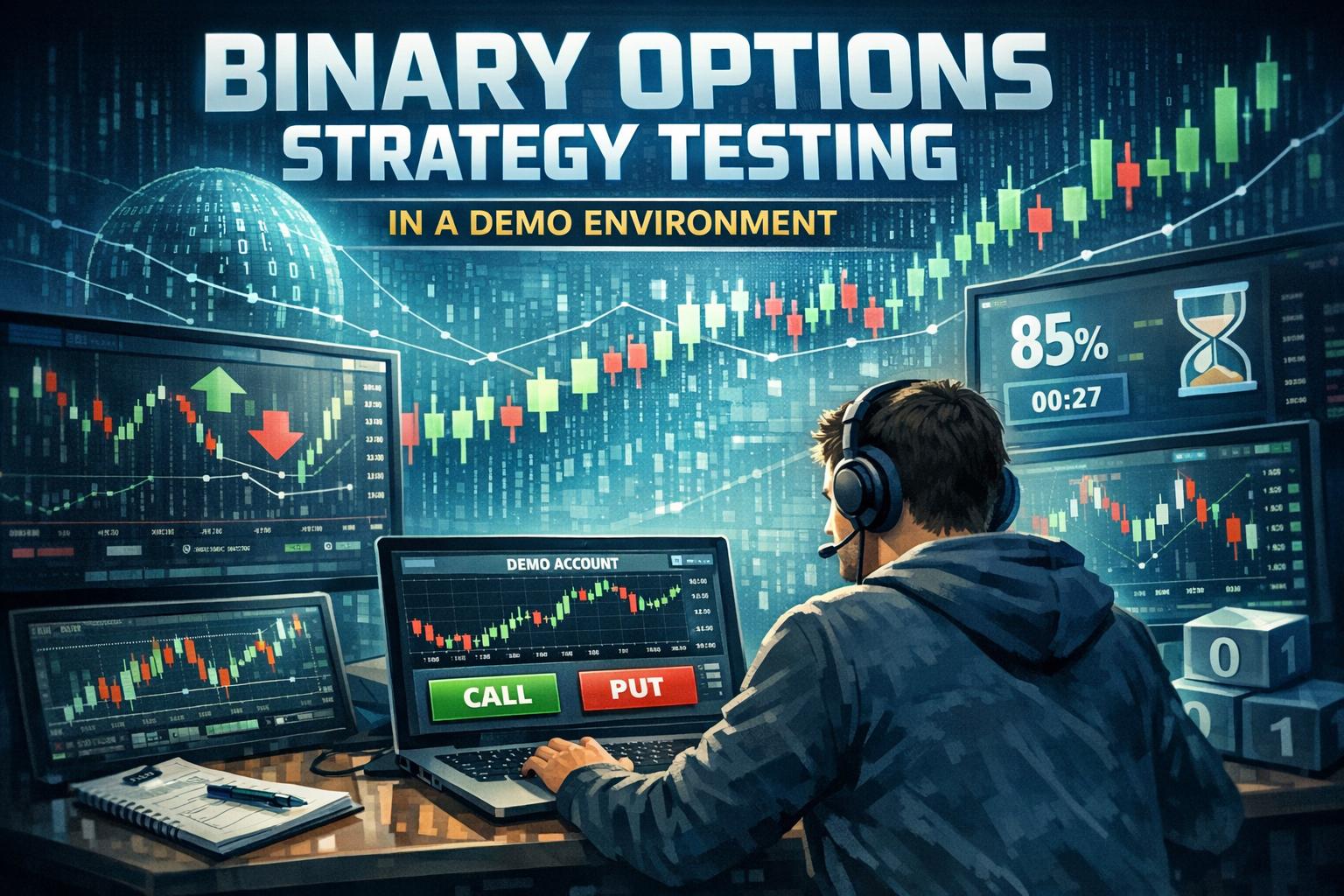
Understanding Binary Options
Binary options are financial derivatives that allow traders to speculate on the short-term price movement of underlying assets. These assets commonly include stocks, indices, commodities, and currency pairs. Unlike traditional investment instruments where profits and losses fluctuate according to the magnitude of price movement, binary options are structured around a fixed outcome. The trader predicts whether the price of the chosen asset will be above or below a specified level at a predetermined expiration time.
The defining feature of binary options is their all-or-nothing payout structure. If the trader’s prediction is correct at expiration, a fixed return is paid. If the prediction is incorrect, the initial investment is forfeited. This structure simplifies the calculation of potential outcomes because both risk and reward are known in advance. However, this simplicity should not be confused with ease of profitability. The limited margin between correct and incorrect predictions, combined with time-based expirations, makes precise decision-making essential.
Binary options contracts are typically categorized as call or put options. A call option is chosen when a trader expects the asset’s price to rise above the current level by expiration. A put option is selected when a decline is anticipated. The expiration time can range from seconds to hours or longer, depending on the platform and product. The short-term nature of many binary options increases exposure to market volatility and requires disciplined execution.
The Importance of Strategy Testing
Effective participation in binary options trading requires more than intuition. Because outcomes depend on both price direction and timing, structured strategies are necessary. Strategy testing provides a controlled framework for evaluating whether a trading plan has consistent merit. Rather than relying on isolated trades, traders evaluate patterns of performance over time.
Testing strategies before committing real capital allows traders to identify weaknesses in their approach. It helps confirm whether technical indicators are applied correctly, whether expiration periods align with asset behavior, and whether risk parameters are realistic. Without testing, traders may attribute short-term wins to skill when they are the result of chance, or abandon effective approaches prematurely due to temporary losses.
A systematic testing process introduces discipline. It encourages traders to document entries, exits, and reasoning behind each position. This documentation supports objective analysis and reduces reliance on memory, which can be biased by recent outcomes. Over time, structured strategy testing builds a database of performance evidence that informs decision-making.
Benefits of Using a Demo Environment
A demo environment is a simulated trading platform that replicates market conditions using virtual funds. Reputable brokers provide demo accounts that mirror the pricing, expiration settings, and asset offerings available in live accounts. Because no real money is at stake, traders can experiment with various methods without financial risk.
One practical advantage of a demo environment is exposure to different market scenarios. Traders can test strategies during trending markets, ranging conditions, and periods of heightened volatility. Since data typically reflects real-time or near real-time pricing, the experience closely resembles live execution. This realism provides valuable feedback on order placement, reaction time, and indicator interpretation.
Another benefit lies in platform familiarity. Each trading interface contains specific charting tools, order entry mechanisms, and analytical features. Practicing within a demo setup allows traders to learn how to navigate the system efficiently. This reduces operational errors when transitioning to live trading, such as selecting incorrect expiration times or entering unintended trade sizes.
The demo environment also supports experimentation with capital allocation methods. Traders can test fixed investment amounts, percentage-based risk models, or other allocation frameworks without exposing personal funds. By analyzing results across multiple approaches, more informed choices can be made regarding risk exposure.
Refining Trading Strategies
Strategy refinement in a demo account often focuses on three interconnected dimensions: timing, risk management, and technical analysis. Timing is critical in binary options because even accurate directional forecasts can fail if the expiration window is poorly chosen. Testing helps determine whether short expirations align with asset volatility or whether longer durations yield more consistent results.
Risk management is equally significant. Since losses in binary options can represent the full investment amount per trade, controlling position size is essential. Through systematic testing, traders can observe the effects of risking different percentages of capital per trade. Conservative allocation typically enhances sustainability, while aggressive scaling may produce volatility in account balance.
Technical analysis tools are commonly used in binary options strategies. Indicators such as moving averages, oscillators, and support or resistance levels may guide entry decisions. A demo account allows traders to evaluate the predictive reliability of these tools in specific market conditions. Some indicators may perform effectively in trending markets but produce false signals in range-bound environments. Refinement involves identifying these distinctions and adjusting criteria accordingly.
In addition to indicator-based strategies, price action analysis is frequently tested. Traders may examine candlestick formations, breakout patterns, or momentum shifts. Recording the frequency and outcome of such patterns in a controlled environment enables more objective assessment than relying on isolated observations.
Psychological Preparedness
Although demo trading eliminates financial risk, it still offers psychological insights. Binary options trading can generate pressure due to fixed expiration times and rapid outcome resolution. Observing emotional reactions during simulated trades helps traders recognize tendencies such as impatience, overconfidence, or hesitation.
Developing emotional neutrality is a central component of trading performance. In a demo environment, traders can practice following predefined rules without deviation. Consistent adherence to strategy parameters builds habits that are transferable to live trading. When real funds are eventually at stake, familiarity with the process reduces impulsive decision-making.
It is important to acknowledge that demo trading does not fully replicate the emotional intensity of live markets. The absence of real financial consequences can lead to more relaxed behavior. Nonetheless, establishing structured routines in a simulated setting lays a foundation for disciplined conduct later.
Steps to Effective Strategy Testing
Structured testing begins with the development of a clear trading plan. This plan should define the asset classes considered, the conditions under which trades are entered, the expiration periods selected, and the capital allocation rules applied. Without written parameters, performance measurement becomes subjective.
Testing should occur over a sufficient sample size. Evaluating a strategy after only a handful of trades may produce misleading conclusions. A larger dataset provides more reliable statistical insight into win rates, average returns, and maximum drawdowns. Recording every trade in a journal or spreadsheet enables detailed analysis.
Consistency during testing is essential. Altering multiple variables simultaneously makes it difficult to identify which factor influences results. Adjustments should be incremental and documented. For example, modifying expiration time while keeping entry criteria constant allows for measurable comparison.
Select a Reliable Trading Platform
The credibility and functionality of the trading platform significantly influence testing effectiveness. A reliable platform should provide transparent pricing, stable execution, and accurate charting tools. Access to multiple asset classes enhances diversification during experimentation.
Educational resources and responsive support services are additional considerations. Platforms that offer detailed tutorials and technical documentation assist traders in understanding available tools. Demo access should not be restricted in ways that limit realistic practice, such as providing outdated data or constrained functionality.
Security and regulatory compliance are also relevant factors. Even during demo usage, traders should evaluate whether the broker operates under recognized financial standards. This assessment becomes particularly important when transitioning to live trading.
Set Clear Objectives
Clear objectives focus strategy testing on measurable outcomes. Objectives may include achieving a defined win rate, reducing drawdown percentages, or validating a specific indicator combination. By articulating targets in advance, evaluation becomes structured rather than reactive.
Objectives should be realistic and time-bound. For instance, testing a strategy over several weeks of varied market conditions can provide comprehensive exposure. Documenting whether predefined benchmarks are met supports rational decision-making about refinement or continuation.
Consistent Evaluation
Evaluation requires both quantitative and qualitative analysis. Quantitative review examines numerical performance metrics such as success percentages, payout averages, and streak patterns. Qualitative review assesses whether trades adhered strictly to established rules.
Patterns often emerge from systematic evaluation. Certain assets may display more predictable responses to specific indicators. Particular trading hours may exhibit higher volatility. Recognizing these patterns enables targeted adjustments rather than broad assumptions.
Continuous feedback cycles strengthen strategy development. Testing, reviewing, adjusting, and retesting form an ongoing process. This iterative approach gradually improves reliability and reduces unnecessary risk exposure.
Transition to Live Trading
After sufficient testing and refinement, traders may consider transitioning to live trading. The shift from simulated funds to actual capital introduces financial consequence, which alters the psychological environment. To manage this transition effectively, initial trade sizes should remain modest.
Beginning with small investments allows traders to observe how emotional responses differ from demo conditions. Monitoring adherence to rules during this phase is critical. If deviations occur, returning temporarily to a demo account may be constructive.
Capital preservation should be a primary objective during early live sessions. Rather than emphasizing rapid gains, traders benefit from validating whether their tested strategies perform similarly under real conditions. Careful comparison between demo and live results can highlight execution differences or slippage effects.
Continued Practice and Adaptation
Financial markets evolve in response to economic developments, policy changes, and shifts in investor behavior. Strategies that perform effectively in one environment may weaken under different conditions. Continuous observation and periodic testing support adaptability.
Even experienced traders often maintain access to demo accounts for experimentation with new indicators or revised parameters. This ongoing practice prevents stagnation and encourages objective evaluation before applying modifications to live accounts.
Adaptation also includes maintaining updated knowledge of asset-specific influences. For example, currency pairs may respond to central bank announcements, while commodities may reflect supply chain developments. Integrating contextual awareness with tested technical frameworks strengthens decision quality.
Binary options trading requires structured preparation, consistent evaluation, and disciplined execution. The use of demo environments for comprehensive strategy testing provides a controlled foundation for learning and refinement. By combining methodical planning with adaptive practice, traders can approach live markets with greater clarity and measured risk exposure.
This article was last updated on: August 1, 2026