
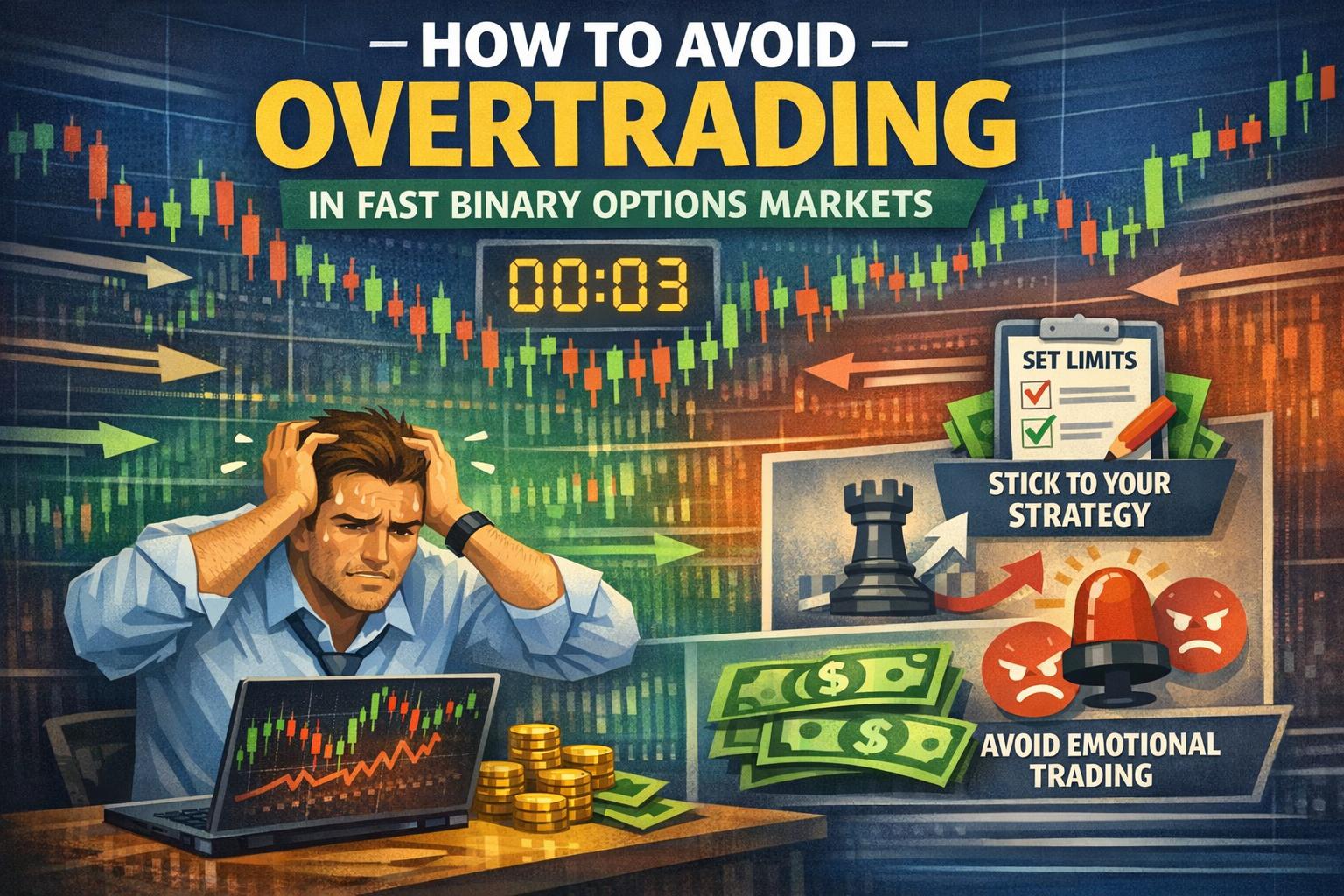
Understanding Overtrading in Binary Options
Overtrading in binary options refers to the practice of placing an excessive number of trades within a limited timeframe, often without sufficient analysis or strategic alignment. In the context of binary options, where each trade has a fixed expiry time and predefined payout, the speed of execution can encourage frequent decision-making. While active participation is inherent to short-term trading, overtrading goes beyond structured activity and reflects a breakdown in discipline, planning, or risk control.
Binary options markets are structured around simple directional outcomes: an asset will either meet a specified condition at expiry or it will not. This simplicity can create the perception that trading decisions can be made quickly and repeatedly without significant consequences. However, each trade carries transaction costs, opportunity costs, and capital exposure. When these trades accumulate without clear justification or edge, performance can deteriorate rapidly.
Overtrading does not necessarily mean placing hundreds of trades per day. It is better defined as trading beyond the boundaries of a predefined strategy. Even a small number of trades can constitute overtrading if they deviate from established criteria. Understanding this distinction is essential for developing sustainable trading behavior.
Identify the Causes of Overtrading
Preventing overtrading begins with identifying its underlying causes. In most cases, excessive trading stems from a combination of psychological influences, structural characteristics of the market, and deficiencies in planning. Recognizing these drivers allows traders to intervene before patterns become entrenched.
One common cause is the perception that more trades lead to more opportunities for profit. In probability-based environments such as binary options, traders may believe that increasing trade frequency increases their chances of success. While frequency does create more potential events, it also increases exposure to risk and transaction costs. Without a demonstrable statistical edge, greater frequency amplifies volatility in account performance.
Another factor is the rapid feedback loop inherent in binary options. Because trades settle within minutes or hours, results are immediately visible. This immediacy can encourage reactive trading. A trader who wins may feel compelled to repeat the action, while a trader who loses may attempt to compensate quickly. In both situations, decisions are driven by short-term outcomes rather than long-term expectancy.
A lack of a structured trading plan also contributes significantly. Without defined entry rules, asset selection criteria, timeframe alignment, and risk parameters, traders may rely on instinct or momentary market movements. This reactive approach increases variability and makes it difficult to distinguish between calculated risk-taking and impulsive trading.
Emotional Triggers
Emotional influences play a central role in overtrading. Although trading is often framed as an analytical activity, it inherently involves uncertainty and financial exposure. Two recurring emotional drivers are fear and greed, both of which can subtly shape behavior.
Fear can manifest after a loss, leading a trader to re-enter the market quickly in an attempt to recover capital. This behavior, sometimes described as revenge trading, increases trade frequency without improving trade quality. Fear may also drive premature exits from structured approaches, prompting frequent adjustments to strategy and inconsistent execution.
Greed often appears during periods of success. A sequence of winning trades can foster overconfidence, resulting in increased position size or higher trade frequency. Rather than adhering to predetermined parameters, the trader may expand activity under the assumption that recent success will continue. This shift from measured trading to opportunistic trading undermines long-term consistency.
In addition to fear and greed, boredom and overconfidence can contribute to unnecessary trades. Binary options platforms typically operate continuously during market hours, and constant price movement can create a sense that inaction represents missed opportunity. Maintaining discipline in such an environment requires conscious effort.
Developing a Trading Plan
A comprehensive trading plan is one of the most effective tools for preventing overtrading. A well-structured plan acts as a reference framework that governs decision-making and limits reactive behavior. It transforms trading from a sequence of isolated decisions into a systematic process.
An effective trading plan defines the specific market conditions under which a trade is permitted. This may include technical signals, volatility thresholds, time-of-day filters, or macroeconomic considerations. By narrowing the circumstances that qualify for entry, the trader reduces unnecessary exposure.
The plan should also identify clear exit conditions. In binary options, expiry time is predetermined, but the rationale behind selecting a particular expiry should be consistent. Aligning expiry intervals with the strategy’s time horizon prevents arbitrary switching between short and long durations.
Risk management rules are an essential component of the plan. This includes predetermined limits on capital allocation per trade, maximum daily loss thresholds, and maximum number of trades per session. These quantitative boundaries discourage spontaneous decision-making.
Documenting the plan in written form increases accountability. When criteria are explicitly defined, deviations become easier to recognize. Journaling trade decisions and reviewing performance periodically further strengthens adherence to the plan.
Risk Management Strategies
Risk management is closely linked to overtrading. When exposure per trade is not clearly defined, traders may compensate for uncertainty by increasing frequency. Establishing firm risk thresholds minimizes this tendency.
A common approach is to allocate a fixed percentage of trading capital to each binary options position. By keeping individual exposure consistent, fluctuations in performance remain manageable. This stability reduces the urgency to recover losses through additional trades.
Setting daily or weekly loss limits provides an additional safeguard. Once a predefined threshold is reached, trading activity is paused. This pause interrupts the potential escalation of losses caused by emotional responses.
Performance tracking also functions as a risk management tool. Monitoring win rates, average return per trade, and overall expectancy offers objective insight into the effectiveness of the strategy. When data is accessible and reviewed regularly, decisions are more likely to remain data-driven rather than emotionally driven.
Use Technology to Your Advantage
Technology plays a substantial role in modern binary options trading. Platforms provide real-time data, charting tools, indicators, and automated features. When used appropriately, these tools can reduce the likelihood of overtrading by reinforcing discipline and objectivity.
Analytical software supports structured evaluation of trading setups. Instead of relying on immediate price movement, traders can apply predefined indicators and filters. This structured analysis slows down decision-making and aligns trades with established criteria.
Backtesting functionality allows traders to evaluate strategies using historical data. By understanding historical performance characteristics, including drawdowns and streaks of losses, traders are better prepared to tolerate normal variance. This preparation reduces impulsive reactions to short-term outcomes.
Trade Alerts and Automation
Trade alerts help maintain focus by notifying traders only when predefined conditions are met. Instead of continuously monitoring charts, traders can wait for specific signals. This selective engagement decreases unnecessary market exposure.
Automated trading systems can further reduce overtrading when properly configured. By executing trades automatically based on predetermined rules, automation eliminates impulsive decision-making at the point of execution. However, automation should not be viewed as a replacement for oversight. Systems require testing, monitoring, and periodic adjustment to remain effective.
The primary advantage of automation is consistency. When human judgment is limited to strategy development rather than moment-to-moment execution, deviations from the plan decrease. Consistency, in turn, reduces variability in trade frequency.
Taking Breaks
Continuous exposure to fast-moving markets can impair judgment. Scheduled breaks introduce structure into trading sessions and prevent fatigue-related decision errors. Even brief intervals away from screens can restore analytical clarity.
Breaks are particularly important after sequences of consecutive wins or losses. In both scenarios, decision-making may become biased by recent outcomes. Temporarily disengaging from trading activity allows for objective reassessment of conditions.
Establishing defined trading hours is another effective method. Rather than participating throughout the entire market session, traders can select specific windows aligned with liquidity and volatility patterns. Outside these windows, trading platforms remain closed. This boundary reduces the likelihood of unnecessary trades.
Continuous Education
Ongoing education contributes to disciplined trading by deepening understanding of market mechanics and strategy design. Knowledge reduces reliance on assumptions and reinforces analytical reasoning.
Studying statistical probability, risk-reward dynamics, and behavioral finance enhances awareness of how outcomes unfold over time. Recognizing that losses are inherent in probabilistic systems helps prevent reactionary overtrading. When traders accept variability as a normal component of performance, they are less inclined to alter approach impulsively.
Reviewing case studies, analyzing historical volatility patterns, and refining technical or fundamental methodologies all support improved decision-making. Continuous improvement should focus on refining strategy quality rather than increasing strategy frequency.
Engaging in simulated trading environments or maintaining detailed trade journals provides additional educational benefit. Simulation offers opportunities to test modifications without financial exposure, while journaling promotes structured reflection.
Long-Term Perspective and Performance Evaluation
A broader perspective is essential for addressing overtrading effectively. Binary options trading, despite its short-term nature, should be evaluated over extended sample sizes. Individual trade outcomes carry limited informational value. Performance should be assessed based on aggregate data across many trades executed according to consistent criteria.
When traders adopt a long-term evaluation framework, the emphasis shifts from immediate outcomes to statistical expectancy. This shift reduces pressure to participate in every market fluctuation. Selectivity becomes aligned with performance improvement rather than inactivity.
Periodic performance reviews support this perspective. By analyzing metrics such as total trades executed, percentage adherence to plan, risk-adjusted returns, and deviation frequency, traders can identify patterns of excessive activity. Corrective measures can then be implemented systematically.
Accountability mechanisms also contribute to sustained discipline. Whether through formal reporting structures, peer discussion groups, or personal performance audits, consistent review reinforces adherence to predefined limits.
Conclusion
Overtrading in binary options markets is primarily a behavioral and structural challenge rather than a technical one. Rapid trade cycles, immediate feedback, and accessible platforms create conditions in which frequent participation appears advantageous. However, without defined parameters, increased frequency tends to reduce decision quality and increase financial exposure.
Preventing overtrading requires a structured approach. Identifying emotional influences, implementing comprehensive trading plans, applying consistent risk management practices, and leveraging technological tools all contribute to disciplined execution. Scheduled breaks, performance tracking, and continuous education further reinforce stability.
Sustainable participation in binary options markets is grounded in consistency, statistical reasoning, and clearly defined boundaries. By emphasizing quality over quantity and aligning activity with predefined strategy rules, traders can reduce unnecessary exposure and maintain a balanced trading process over time.
This article was last updated on: April 10, 2026