
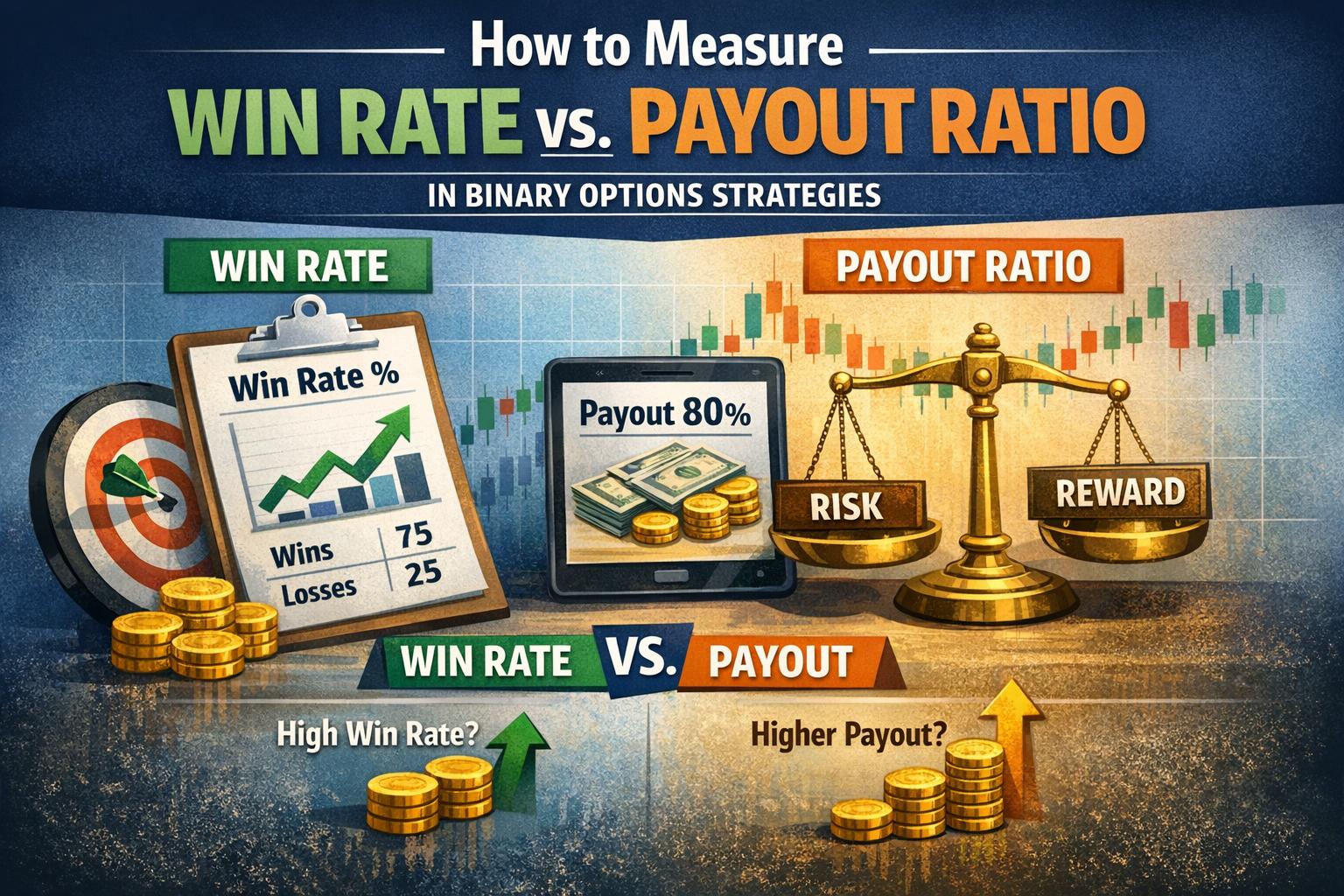
Understanding Win Rate in Binary Options
The win rate in binary options trading refers to the proportion of trades that close in profit compared to the total number of trades executed. It is typically expressed as a percentage and serves as a primary metric for evaluating trading performance. If a trader places 100 trades and 60 of them expire in-the-money, the resulting win rate is 60%. While the calculation itself is straightforward, the interpretation of this figure requires a broader analytical framework.
In binary options, outcomes are fixed: a trade either results in a predefined return or a loss of the invested amount. Because of this structure, the win rate becomes a central measurement of consistency. However, a win rate by itself does not determine whether a trading approach is profitable. The surrounding variables, including the payout ratio, capital allocation strategy, transaction timing, and asset selection, all shape how meaningful that percentage truly is.
A trader operating with a 55% win rate may be profitable under certain payout conditions, while another with a 70% win rate could still incur losses if payout ratios are too low. Therefore, the win rate must always be evaluated within the operational environment in which trades occur.
Calculating the Win Rate
The formula used to determine the win rate is:
Win Rate (%) = (Number of Winning Trades / Total Number of Trades) × 100
This equation provides a statistical snapshot of performance over a defined sample of trades. The reliability of this snapshot depends on sample size. A small number of trades may produce misleading results due to random variation. For example, achieving eight wins out of ten trades yields an 80% win rate, but such a limited dataset does not necessarily reflect the sustainability of a strategy.
As the number of trades increases, the win rate becomes more representative of actual performance. Traders who test strategies over hundreds of trades generally obtain a more stable and statistically meaningful measure. This process is often referred to as performance sampling, and it helps reduce distortions caused by short-term volatility.
Interpreting Win Rate in Context
Interpreting win rate requires an understanding of probability and distribution. Binary options outcomes are binary by design, yet market conditions are not. Asset prices fluctuate due to macroeconomic data, market sentiment, liquidity cycles, and institutional activity. A strategy that performs well in trending markets may deteriorate in ranging environments. Consequently, a trader’s win rate can shift over time.
Consistency in win rate across varying conditions is often more significant than achieving a temporarily high percentage. Traders frequently analyze win rates relative to market states, such as high volatility sessions, low liquidity periods, or major news releases. By segmenting performance data, it becomes possible to identify strengths and weaknesses within the strategy framework.
It is also crucial to differentiate between short-term win rate and long-term expectancy. A high win rate without adequate payouts may not cover trading costs or risk exposure. Therefore, the win rate becomes one part of a broader performance equation.
The Payout Ratio Explained
The payout ratio defines the percentage return offered by a broker when a binary options trade expires successfully. If a $100 trade offers an 80% payout, a winning position returns $180, which includes the initial stake plus $80 in profit. If the trade loses, the entire $100 stake is forfeited.
Payout ratios vary across brokers and assets. Currency pairs, commodities, indices, and equities may carry different payout structures depending on liquidity and volatility. Market demand and perceived risk influence how brokers structure these returns. High-demand or high-volatility assets sometimes offer increased payouts, although conditions differ among trading platforms.
Understanding payout ratio is critical because it directly affects the break-even win rate. Traders cannot evaluate performance solely by counting winning trades; they must compute whether the average gain from winners outweighs the total loss from unsuccessful trades.
Break-Even Analysis
The break-even win rate can be calculated using the payout ratio. For example, with an 80% payout, the formula to determine the required win rate for break-even is:
Break-even Win Rate = 1 / (1 + Payout Ratio)
When the payout ratio is 0.8 (or 80%), the break-even threshold is approximately 55.6%. This means a trader must win more than 55.6% of trades to generate profit over time. Below that level, cumulative losses begin to exceed gains.
If the payout ratio falls to 70%, the required win rate increases to approximately 58.8%. Conversely, if the payout reaches 90%, the break-even threshold declines to roughly 52.6%. This mathematical relationship illustrates why a trader’s performance cannot be judged without considering the payout structure.
Variables Influencing the Payout Ratio
Broker policy remains a central determinant of payout ratios, but other elements also contribute. Market volatility plays a significant role. During major economic events, when price movements can become unpredictable, brokers may adjust payouts to reflect elevated risk exposure. Asset liquidity also matters. Highly liquid markets tend to produce narrower spreads and, in some cases, more stable payout offerings.
Competition among brokers can influence payout offerings as well. Platforms seeking client engagement may temporarily increase ratios as part of promotional structures, although sustainability of such offers depends on internal risk management models.
Balancing Win Rate and Payout Ratio
A sustainable binary options strategy requires balancing win rate and payout ratio to achieve positive expectancy. Expectancy refers to the average amount a trader can expect to win or lose per trade over a series of transactions. It incorporates both probability and reward size.
For example, assume a trader maintains a 60% win rate with an 80% payout ratio. Over 100 trades with $100 risked per trade, 60 winning trades would generate $4,800 in profit, while 40 losing trades would result in $4,000 in losses, yielding a net gain of $800. However, if the payout ratio declines to 70%, the same win rate produces only $4,200 in profit against $4,000 in losses, resulting in a net gain of $200. Small changes in payout structures significantly affect profitability.
Therefore, win rate and payout ratio should never be viewed in isolation. They form an interdependent system that determines long-term financial outcomes.
When Win Rate Carries Greater Weight
In scenarios where payout ratios are modest, achieving and maintaining a high win rate becomes a priority. Strategies that rely on short expiration times or frequent trades often encounter payout levels below 75%. Under these conditions, statistical precision in trade selection is essential.
Traders focusing on high win rate strategies typically emphasize technical confirmation, trend verification, and strict entry criteria. The objective is to limit exposure to uncertain setups and increase the probability of controlled, repeatable outcomes. Over time, consistency rather than magnitude of individual returns drives overall results.
When the Payout Ratio Becomes Central
When payout ratios exceed 85% or approach 90%, traders may tolerate a moderately lower win rate while remaining profitable. In such environments, fewer trades may be executed, but each successful position yields a proportionally larger return.
This approach often relies on selective trade identification, sometimes involving longer expiration periods or alignment with macroeconomic signals. Rather than focusing on frequent small gains, the emphasis shifts toward optimizing reward relative to risk. Nonetheless, risk management remains critical, as a series of losses can erode capital rapidly.
Risk Management Considerations
Win rate and payout ratio calculations assume consistent position sizing. However, traders frequently adjust capital allocation relative to account balance. Risk management principles commonly suggest limiting exposure per trade to a fixed percentage of available capital. This practice reduces the probability of significant drawdowns during losing streaks.
A stable win rate does not eliminate the possibility of consecutive losses. Statistical variance allows for clusters of losing trades even in profitable systems. Without disciplined position sizing, these sequences can impair overall performance.
Maintaining detailed trading records enables assessment of whether win rate fluctuations arise from market shifts, execution errors, or structural weaknesses within the strategy. Data-driven adjustments are more reliable than reactive changes based on short-term outcomes.
Backtesting and Forward Testing
Developing alignment between win rate and payout ratio requires systematic testing. Backtesting involves applying a trading strategy to historical price data to evaluate hypothetical performance. While it does not guarantee future results, it offers insights into how the strategy might behave under various market conditions.
Forward testing, often conducted through demo accounts or small-scale live trading, allows traders to observe real-time execution dynamics. Differences between theoretical and actual outcomes can arise due to slippage, timing precision, or platform mechanics.
Through iterative testing, a trader can refine entry criteria, expiration timing, and capital allocation to enhance expectancy. Monitoring win rate stability across sample sizes strengthens confidence in the approach.
Statistical Perspective on Long-Term Performance
Binary options trading can be framed probabilistically. Each trade represents an independent event with defined risk and reward parameters. Over a large number of trades, results tend to approach statistical expectation.
A trader operating with a proven 58% win rate under an 85% payout ratio can estimate long-term average returns with reasonable accuracy, assuming stable conditions. However, deviations may occur due to structural market changes, broker adjustments, or evolving volatility profiles.
It is therefore advisable to reassess performance metrics periodically. Comparing rolling win rate averages across sequential trade blocks can reveal shifts in effectiveness. Consistent monitoring prevents small inefficiencies from compounding into prolonged performance decline.
Strategic Adaptation to Market Conditions
Financial markets are dynamic. Trends, consolidation phases, and sudden reversals require adaptive strategies. A system optimized for steady currency pair movement may underperform during erratic commodity pricing or low-volume trading hours.
Adjustments to strategy parameters, including expiration time or asset selection, can help maintain favorable alignment between win rate and payout structure. Traders who remain responsive to empirical data rather than rigidly attached to fixed assumptions often preserve more stable performance metrics.
Adaptation does not imply constant change. It involves measured, data-supported modifications that retain the statistical foundation of the original framework.
Conclusion
The interaction between win rate and payout ratio defines the structural foundation of profitability in binary options trading. Win rate measures consistency in predicting price direction, while payout ratio determines the monetary value of correct predictions. Neither metric functions effectively in isolation. Sustainable performance emerges from analyzing both dimensions in conjunction with risk management and statistical evaluation.
Through systematic calculation, break-even assessment, and iterative testing, traders can align strategy parameters with realistic market behavior. By maintaining clear records and periodically reviewing results, it becomes possible to preserve favorable expectancy despite shifting conditions.
Binary options trading depends on measurable probabilities and predefined return structures. A disciplined approach grounded in statistical reasoning allows both win rate and payout ratio to serve as practical tools for evaluating and refining strategy performance over time.
This article was last updated on: March 22, 2026