
Understanding Daily Loss Limits in Binary Options Trading
In the world of binary options trading, effective risk management is essential for maintaining long-term participation in the market. Binary options are structured around fixed outcomes: a trader either receives a predetermined payout or loses the amount invested in a trade. Because of this all-or-nothing payoff structure, gains and losses can occur rapidly. Without clearly defined boundaries, a series of unsuccessful trades in a short period can significantly reduce trading capital.
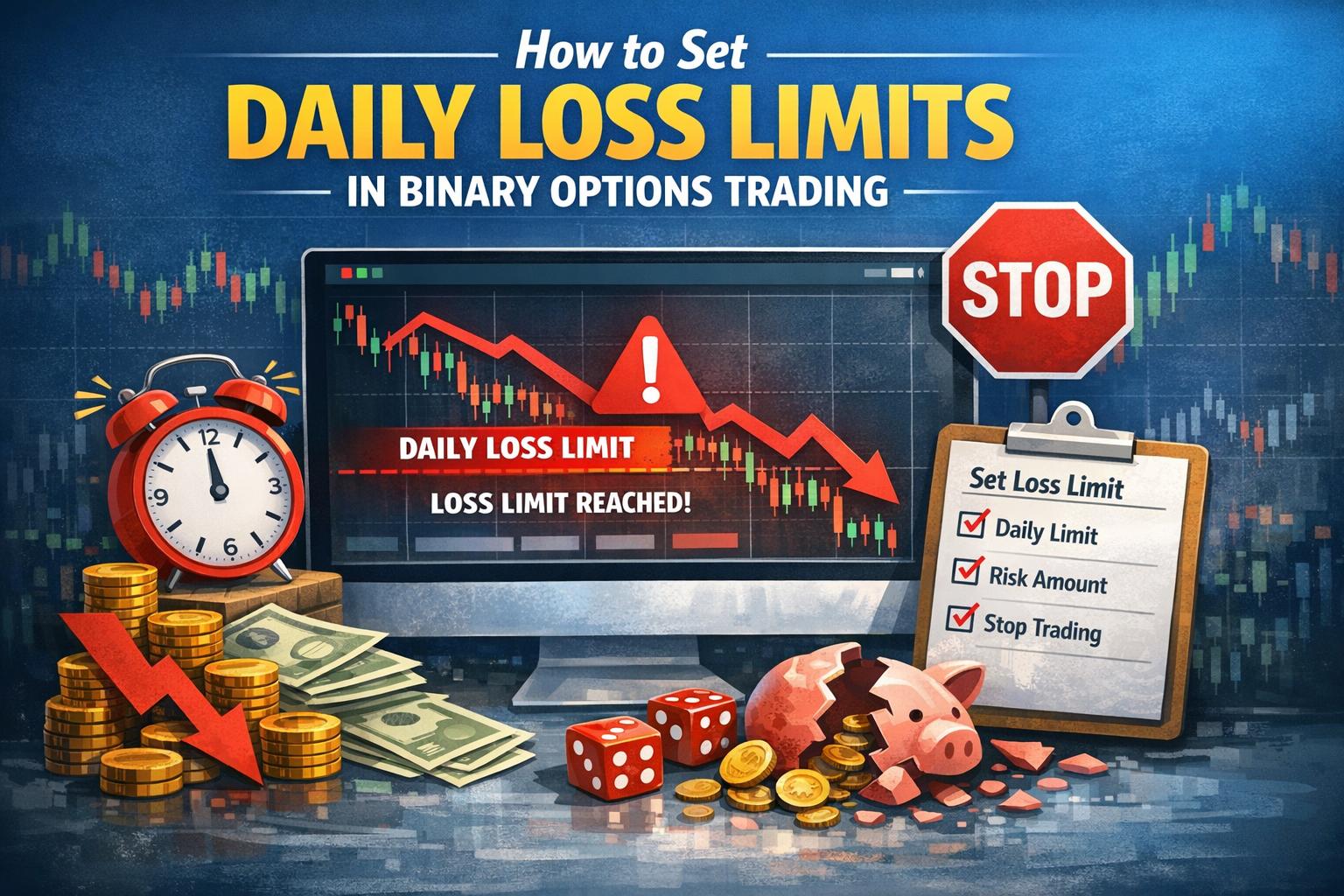
One of the most practical tools for managing this risk is the establishment of daily loss limits. A daily loss limit defines the maximum amount of money a trader is willing to lose within a single trading day. Once this threshold is reached, trading activity stops for the day. This approach places a structured ceiling on potential losses and supports consistency in decision-making.
The Nature of Risk in Binary Options Trading
Binary options differ from many other financial instruments because the potential profit and loss are known before the trade is placed. Traders predict whether the price of an underlying asset will be above or below a specified level at expiration. If the prediction is correct, a fixed return is earned. If incorrect, the invested amount is forfeited.
This simplicity can create a misleading sense of predictability. While the payout is fixed, the probability of success depends on market conditions, timing, and the trader’s analytical approach. Even with a well-developed strategy, losses are inevitable. A sequence of unsuccessful trades can accumulate quickly, especially if position sizes are not carefully controlled.
Market volatility compounds this issue. Economic news releases, geopolitical events, and unexpected data can influence price movements within minutes. Traders who remain active during such periods without predefined limits may experience rapid account drawdowns. Establishing a daily loss limit introduces an external control mechanism that reduces exposure to extended periods of unfavorable conditions.
Why Set Daily Loss Limits?
Daily loss limits serve several practical functions within a broader risk management framework. They create structure, enforce capital preservation, and contribute to a more systematic trading process.
Capital Protection is the primary objective. Trading capital functions as operating inventory. Once lost, it cannot generate future returns. By capping daily losses, traders reduce the probability of significant account depletion within a short timeframe. This is particularly relevant in binary options, where repeated losses can have an immediate and noticeable impact.
Consistency and Discipline are strengthened through predetermined limits. Trading plans are most effective when rules are followed without modification during live market conditions. A daily loss threshold acts as a non-negotiable parameter. When consistently applied, it supports structured behavior, even during volatile sessions.
Reduction of Impulsive Decisions is another benefit. After a series of losses, traders may be tempted to increase trade size in an attempt to recover quickly. This behavior, often referred to as escalating risk exposure, increases the probability of larger losses. A predefined loss cap interrupts this cycle by automatically ending the session once the limit is reached.
The Psychological Dimension of Loss Control
Although binary options trading is based on measurable probabilities and technical or fundamental analysis, psychological stability plays a central role in performance. Emotional responses to loss, such as frustration or overconfidence after short-term gains, can influence decision-making.
A daily loss limit serves as a structural guardrail. Instead of relying solely on willpower to stop trading during unfavorable conditions, traders use a predetermined rule. This reduces reliance on moment-to-moment judgment, which can be influenced by stress or fatigue.
Maintaining decision consistency is particularly important because binary options trades often have short expiration times. Rapid trade cycles mean that multiple positions can be placed within minutes. Without boundaries, this speed can amplify the impact of emotional reactions. By ending trading activity after a fixed loss amount, the trader gains time to review performance objectively before re-entering the market on another day.
Determining an Appropriate Daily Loss Limit
A daily loss limit should align with overall financial objectives, account size, and strategic parameters. There is no universally applicable percentage, but the limit must be proportionate to available capital.
Account Size is the foundational variable. Many traders determine their maximum daily loss as a small percentage of total account equity. A commonly referenced range is between 1% and 3% of the account balance per day. For example, with an account balance of 5,000 units of currency, a 2% daily loss limit would equate to 100 units. Once losses equal this amount, trading stops for that session.
This percentage-based approach adapts naturally to account growth or decline. As the account increases, the absolute daily limit rises proportionally. Conversely, if the account decreases, the allowable daily loss becomes smaller, providing an added layer of protection.
Individual Risk Tolerance also plays a significant role. Some traders prefer highly conservative exposure, accepting smaller daily thresholds to preserve capital stability. Others, operating with more aggressive strategies, may tolerate slightly higher limits. Regardless of preference, the limit should be low enough to prevent substantial damage but high enough to accommodate normal variations in strategy performance.
Trading Strategy Characteristics must be considered. High-frequency approaches that place numerous trades per session may require tighter individual trade risk, which can influence the overall daily cap. Strategies that rely on specific market sessions or limited trade setups may justify narrower daily limits because the number of opportunities is inherently restricted.
Integrating Daily Loss Limits Into Position Sizing
Daily loss limits are most effective when combined with structured position sizing. Each binary options trade involves a predetermined investment amount. Determining how much to allocate per trade should be directly connected to the daily loss boundary.
For instance, if the daily loss limit is set at 2% of account equity, a trader may decide to risk 0.5% per trade. Under this structure, four consecutive losses would reach the daily threshold. This creates a mathematical relationship between individual trades and the maximum allowable daily drawdown.
This alignment prevents isolated decisions from exceeding the broader framework. Without such coordination, placing several larger-than-average trades could surpass the daily cap before the trader recognizes the accumulation of losses. Structured allocation maintains consistency and predictability.
Practical Implementation of Daily Loss Controls
Implementation can be manual or automated, depending on the features provided by the trading platform.
Platform-Based Controls are available on some systems that allow traders to define maximum daily loss thresholds. Once reached, the platform may restrict further trading activity until the next session. Automated enforcement eliminates the possibility of overriding personal rules during periods of stress.
In cases where automated limits are unavailable, manual monitoring becomes necessary. This involves tracking cumulative daily performance and ceasing activity immediately after reaching the predefined loss amount. Accurate record keeping is essential in such situations. A real-time log of trades ensures that calculations remain precise throughout the session.
Session Planning enhances implementation. Before markets open, traders can define acceptable conditions, maximum trades for the day, and the loss threshold. Documenting this plan reinforces commitment to the rule set. When the limit is reached, trading activities for that day conclude without exception.
Reviewing and Adjusting Daily Loss Limits
Daily loss limits should not remain static without periodic evaluation. As trading experience expands and account size evolves, adjustments may be appropriate. However, modifications should be based on performance analysis rather than short-term reactions.
Performance reviews can include examining win rates, payout ratios, maximum historical drawdowns, and streak patterns. If data indicates that a strategy typically experiences brief losing streaks before returning to profitability, the daily loss threshold may be structured to accommodate those patterns without exposing the account to excessive risk.
Conversely, if repeated daily limits are frequently reached, this may signal the need to reassess the underlying strategy rather than increasing the loss cap. Raising the daily allowance solely to accommodate ongoing underperformance undermines the purpose of the control mechanism.
Daily Loss Limits and Long-Term Sustainability
Binary options trading requires a long-term perspective. Short sequences of wins or losses are statistically inevitable, but overall success depends on preserving sufficient capital to allow a strategy’s expected value to manifest over time. Daily loss limits contribute to this sustainability by preventing disproportionately large setbacks in a single session.
Account longevity is a core metric of trading performance. Traders who avoid significant daily drawdowns maintain flexibility to adapt strategies, refine analytical methods, and respond to changing market conditions. Conversely, large short-term losses can reduce trading capacity and increase pressure to recover, complicating decision-making.
Structured daily limitations create a stable operating environment. Each trading day is approached as an independent performance cycle with defined risk parameters. Over weeks and months, this consistency can lead to more predictable equity fluctuations and clearer performance analysis.
Common Misconceptions About Daily Loss Limits
One misconception is that daily loss limits restrict profit potential. In practice, the limit only applies to losses, not gains. Traders are free to realize profits beyond their daily risk allowance. The purpose is not to constrain opportunity but to control downside exposure.
Another misunderstanding is that experienced traders do not require such limits. While experience improves strategic execution, it does not eliminate market uncertainty. Even advanced traders encounter unexpected volatility. Structured limits function as a risk management tool independent of skill level.
It is also sometimes assumed that small accounts do not need formal limits. However, smaller accounts are more vulnerable to rapid depletion. Percentage-based caps are particularly relevant in these cases because they scale exposure relative to available capital.
Conclusion
Daily loss limits represent a foundational element of structured risk management in binary options trading. By defining the maximum acceptable loss within a single trading day, traders establish clear boundaries that protect capital and support disciplined execution. These limits integrate with account size, position sizing, and strategic objectives to form a comprehensive control framework.
Through consistent application, periodic evaluation, and alignment with overall trading methodology, daily loss limits contribute to sustained participation in the market. While they do not eliminate risk, they create a measurable structure within which risk can be managed in a controlled and systematic manner.
This article was last updated on: April 3, 2026