
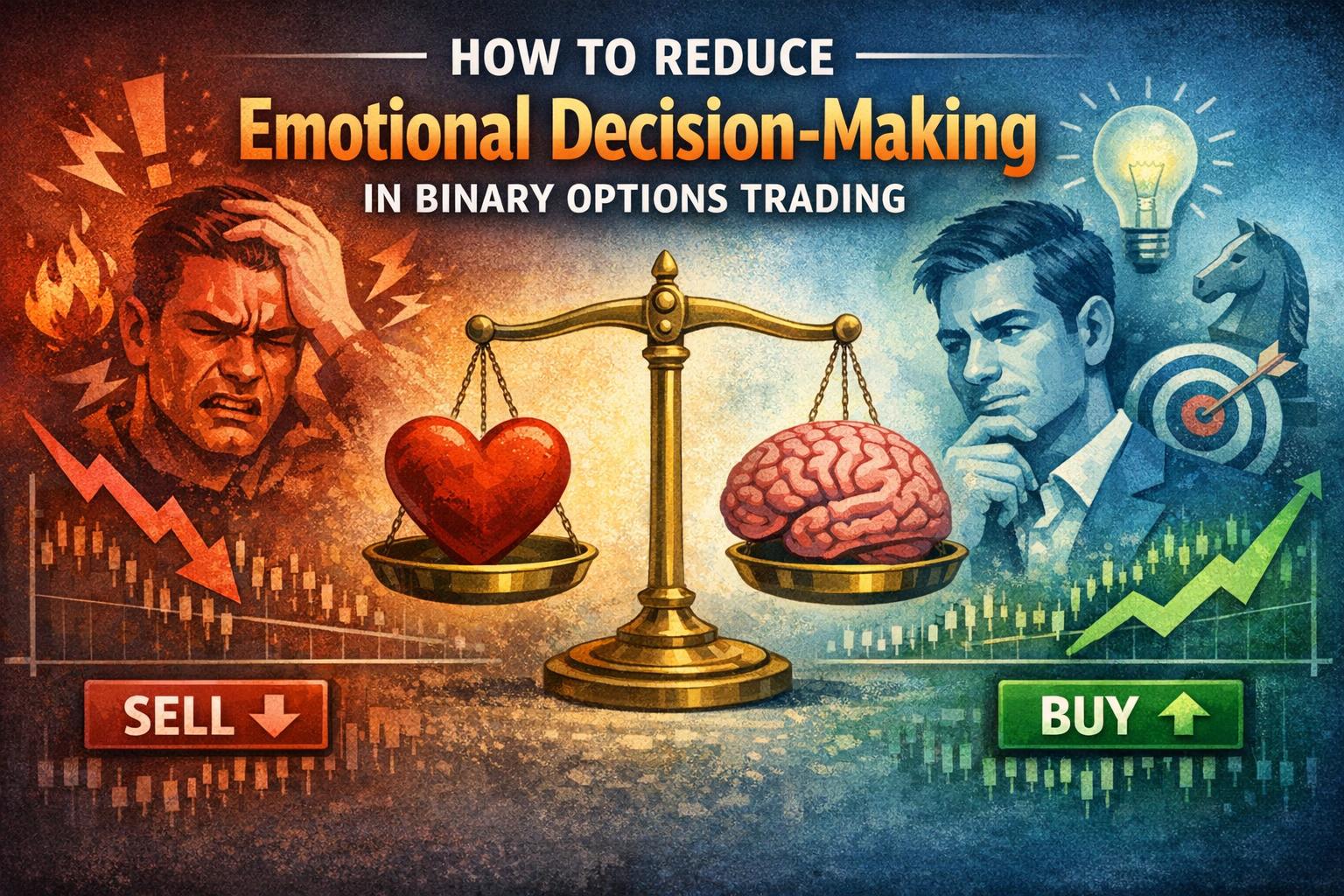
Understanding Emotional Decision-Making in Binary Options Trading
Binary options trading attracts participants because of its structural simplicity. A trader is typically required to determine whether the price of an asset will close above or below a specified level within a fixed time frame. Despite this apparent clarity, the decision-making process behind each trade can become complex. The limited time horizon, predefined payout, and all-or-nothing outcomes often intensify psychological pressure. As a result, trading behavior may shift away from analytical reasoning toward emotional reaction.
Emotional decision-making occurs when feelings, impulses, or psychological discomfort override structured judgment. In binary options trading, where results are resolved quickly and feedback is immediate, emotional responses can be amplified. Gains may generate overconfidence, while losses may produce frustration or urgency. Understanding how these emotional processes operate is essential for traders who aim to maintain consistency and discipline over time.
The Impact of Emotions on Trading
Financial markets operate independently of individual expectations. However, traders often interpret price movement in personal terms. A winning trade may validate their skill, while a losing trade may feel like a failure. This personalization of outcomes can introduce unnecessary bias. Two of the most influential emotions in speculative trading are fear and greed, though other psychological states such as regret, hope, and impatience also play a role.
Fear often emerges after experiencing losses or during periods of uncertainty. A trader who has recently incurred several losing positions may hesitate to enter a valid setup, even if it aligns with their trading strategy. Fear can also manifest as premature exit decisions, where an individual closes a position early to avoid potential loss, even when statistical evidence supports holding the trade to expiration.
Greed, by contrast, may encourage excessive exposure. After a sequence of successful trades, a trader may increase position size beyond planned limits or enter additional trades without sufficient analysis. In binary options, where position sizes are usually fixed per contract, this may involve increasing the allocation per trade or opening multiple simultaneous positions. Such behavior can distort risk management and magnify volatility in overall account performance.
Other emotional influences are more subtle. Regret may cause a trader to avoid valid trades after missing a previous opportunity. Hope may lead to maintaining a flawed perspective despite contradictory market evidence. Impatience can prompt participation in low-quality setups simply to remain active. Each of these responses shifts the trader’s attention from objective assessment toward emotional resolution.
Recognizing Cognitive Biases
Beyond immediate emotional reactions, cognitive biases affect how traders interpret market information. These biases are systematic patterns of deviation from rational judgment. Because binary options involve rapid decision cycles, the effects of cognitive bias may be intensified by time constraints.
Confirmation bias occurs when traders seek or interpret information in a way that confirms their existing beliefs. For example, a trader who anticipates a price increase may focus exclusively on indicators suggesting upward momentum, disregarding signals that imply consolidation or reversal. This bias reduces analytical balance and narrows perception.
Recency bias leads individuals to give disproportionate weight to recent outcomes. If the past few trades were profitable, a trader might assume that success will continue, even without supportive evidence. Conversely, a series of losses may create the expectation of continued failure, discouraging participation in statistically valid opportunities.
Overconfidence bias frequently develops after short-term success. Because binary options provide immediate results, traders may attribute favorable outcomes to personal skill rather than market conditions or probability. Overconfidence can reduce adherence to risk controls and weaken respect for uncertainty.
Another common distortion is the gambler’s fallacy, the incorrect assumption that past independent events influence future outcomes. In binary options, each trade is generally independent of the prior result unless based on correlated analysis. Believing that a loss must be followed by a win, or that a sequence of wins is “due” to end, can interfere with objective strategy implementation.
Recognizing these patterns is the first stage of mitigation. Traders who regularly review their reasoning processes are better positioned to identify whether decisions are derived from structured analysis or biased interpretation.
Strategies to Reduce Emotional Decisions
Reducing emotional decision-making requires a combination of preparation, self-observation, and structured methodology. The objective is not to eliminate emotion entirely, as emotional responses are inherent to human cognition. Instead, the aim is to prevent emotion from determining trading actions without analytical validation.
Developing a Trading Plan
A structured trading plan provides predefined criteria for market engagement. In binary options trading, this plan should clearly define asset selection, time frames, entry conditions, risk allocation, and maximum daily exposure. When these components are established before market participation, the trader can rely on documented guidelines rather than spontaneous judgment.
The plan should also specify acceptable loss limits per session or week. By defining a maximum drawdown threshold, individuals reduce the likelihood of attempting to recover losses through impulsive trades. Consistency in applying position sizing rules contributes to emotional stability, as outcomes remain within projected parameters.
Documenting trade rationale prior to execution further reinforces discipline. Writing a brief explanation of why a trade meets established criteria creates accountability. If the reasoning cannot be articulated clearly, the trade may not align with the plan.
Utilizing Technology and Tools
Technology can assist in minimizing reactive behavior. Many trading platforms allow users to predefine expiration times, investment amounts, and market alerts. By setting parameters in advance, traders avoid adjusting positions in response to rapidly changing market fluctuations.
Analytical tools such as technical indicators, volatility measurements, and statistical performance tracking systems also support rational evaluation. When data replaces assumption, emotional influence is reduced. Automated journaling software can record metrics including win rate, average return, and risk distribution. Reviewing these records regularly promotes objective assessment of performance rather than reliance on memory, which may be influenced by bias.
While algorithmic automation in binary options is more limited than in other markets, semi-automated decision frameworks can still encourage consistency. Structured signal validation processes, for instance, ensure that multiple criteria are satisfied before entry.
Continuous Education and Practice
Knowledge contributes to confidence grounded in competence rather than impulse. Continuous education allows traders to understand market dynamics, probability distributions, and risk-reward structures. When participants comprehend how statistical expectancy operates, short-term fluctuations become less disruptive.
Practicing strategies on demo accounts offers a controlled environment for evaluating behavioral patterns. Simulation exposes individuals to both winning and losing sequences without financial consequence, allowing reflection on emotional responses. Observing how one reacts under simulated pressure can inform adjustments before capital is committed.
Periodic strategy evaluation is equally important. Markets evolve, and methods that previously appeared effective may weaken under different volatility conditions. Objective backtesting and forward-testing provide analytical grounding for strategic revisions, reducing reliance on instinct.
Creating a Supportive Environment
Psychological stability is influenced not only by internal processes but also by environmental conditions. A structured environment reduces external distractions and supports concentration. Maintaining a consistent trading schedule helps align preparation, analysis, and execution with defined time frames rather than sporadic monitoring.
A designated workspace, free from unnecessary interruptions, enables more deliberate thinking. Environmental consistency signals to the mind that trading activity is a structured task requiring analytical attention. This separation between trading and leisure settings may moderate impulsive behavior.
Engagement with knowledgeable peers can contribute to balanced perspective. Discussions with other traders expose individuals to alternative interpretations of market data, reducing the tendency to rely exclusively on personal assumptions. However, participation in group dialogue should supplement, not replace, independent analysis.
Physical well-being also affects cognitive performance. Fatigue, inadequate rest, or prolonged screen exposure can impair judgment and increase susceptibility to impulsive decisions. Structured breaks and defined trading sessions limit overexposure to continuous market stimuli.
Risk Perception and Time Constraints in Binary Options
The fixed expiration structure of binary options introduces unique psychological characteristics. Unlike traditional investments, where positions can be adjusted over time, binary options conclude at a specified moment. This defined endpoint may create urgency and compress decision-making into narrow intervals.
Time pressure can amplify instinctive reactions. When traders perceive limited opportunity to evaluate information, they may default to intuitive reasoning rather than systematic analysis. Short-duration contracts, while attractive for their rapid results, require heightened discipline. Selecting time frames compatible with one’s analytical speed can moderate emotional intensity.
The predetermined payout model also influences risk perception. Because profit and loss parameters are known in advance, traders may underestimate probabilistic uncertainty. The apparent clarity of outcome percentages can create a simplified mental model that overlooks broader market variability. Maintaining an awareness of statistical variance helps balance expectations.
Performance Review and Psychological Accountability
Regular review of trading performance encourages separation between identity and results. A structured journal that includes entry rationale, emotional state at execution, and post-trade reflection fosters transparency. Patterns may emerge indicating that certain emotional conditions correlate with diminished outcomes.
Quantitative metrics such as average return per trade, distribution of wins and losses, and adherence rate to trading rules provide measurable indicators of discipline. If deviations from the trading plan correspond with underperformance, the relationship between emotion and outcome becomes clearer. This evidence-based approach supports behavioral adjustment.
Psychological accountability can also include predefined cooldown periods after consecutive losses or gains. Instead of reacting immediately to outcomes, traders pause and evaluate whether upcoming trades genuinely meet established criteria.
Conclusion
Emotional decision-making represents a structural challenge in binary options trading due to the market’s pace, outcome clarity, and high-risk framework. Fear, greed, regret, and impatience can influence trade selection, position sizing, and timing. Cognitive biases such as confirmation bias, recency bias, overconfidence, and the gambler’s fallacy further complicate judgment.
Mitigating these influences requires intentional structure. A comprehensive trading plan, supported by technological tools, systematic performance tracking, and continuous education, provides a foundation for rational participation. Environmental stability and periodic performance review strengthen consistency.
Binary options trading involves inherent uncertainty. While emotions cannot be removed from the decision-making process, they can be managed through disciplined procedures and objective evaluation. Traders who integrate psychological awareness with structured analysis position themselves to make decisions grounded in evidence rather than impulse.
This article was last updated on: July 26, 2026