
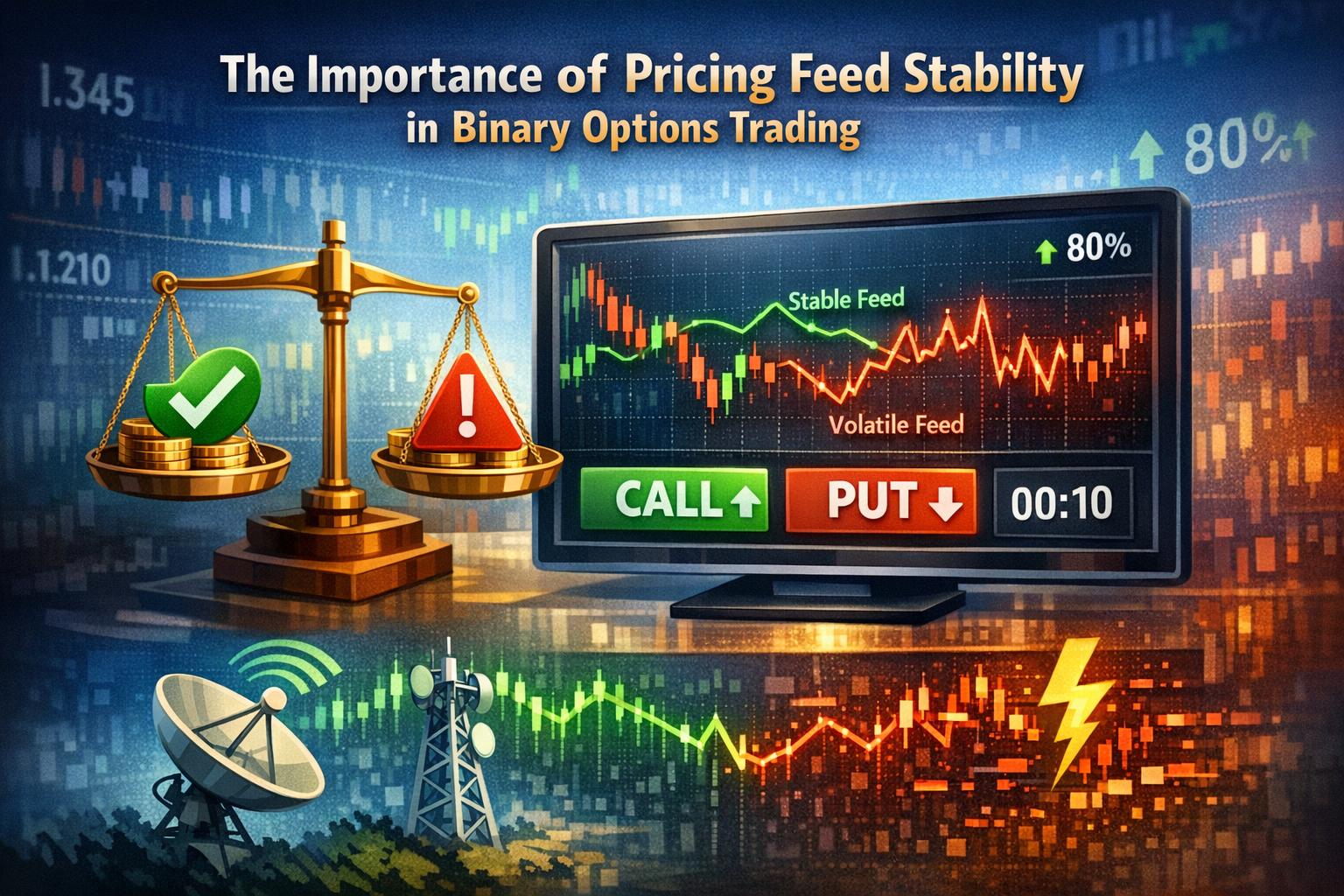
The Significance of Pricing Feed Stability in Binary Options Trading
In binary options trading, every decision is based on a single, measurable factor: the price of an underlying asset at a specified point in time. Unlike other forms of trading where partial gains or losses may depend on magnitude, binary options outcomes are determined by whether price conditions are met within a defined expiry period. Because of this structure, pricing feed stability becomes a central operational requirement rather than a secondary technical feature. The integrity, speed, and consistency of pricing data directly influence execution quality, contract settlement, and trader confidence.
Trading platforms act as intermediaries between broader financial markets and individual traders. The pricing feed they distribute represents the bridge between external liquidity sources and user-facing interfaces. If this bridge is unreliable, inconsistent, or delayed, trading outcomes may deviate from actual market conditions. For participants operating in short-term expiry environments—sometimes measured in minutes or seconds—even minor deviations can materially affect results.
Understanding Pricing Feeds
A pricing feed is a continuous stream of market data that reflects the current bid and ask prices of underlying instruments such as currency pairs, commodities, indices, or equities. These feeds are typically derived from liquidity providers, exchanges, or aggregated over-the-counter sources. The broker integrates this data into its system and displays it to traders through a trading interface.
In binary options markets, pricing feeds serve multiple functions. First, they determine the entry price displayed when a contract is opened. Second, they influence payout calculations, as the entry and expiry price comparison forms the basis of the contract’s final outcome. Third, they define chart visuals and technical analysis tools available within the trading interface.
The quality of a pricing feed depends on accuracy, synchronization, and consistency. Accuracy refers to how closely the displayed price matches the broader market. Synchronization ensures that quote updates reflect real-time activity rather than delayed snapshots. Consistency means that price transitions occur in logical increments without unexplained gaps or spikes.
Because binary options contracts often involve predefined expiry times, even slight discrepancies between the displayed feed and reference market prices may alter trade results. This makes robust data sourcing and processing infrastructure critical to fair trading conditions.
The Role of Feed Stability
Stability in pricing feeds refers to the uninterrupted and coherent transmission of data from the liquidity source to the trader’s platform. It does not imply that market prices themselves are stable, as volatility is inherent in financial markets. Instead, it means that displayed prices fluctuate in alignment with real market activity rather than due to technological or infrastructural limitations.
One key component of stability is low latency. Latency measures the time required for price information to travel from source to platform. In high-frequency or short-expiry environments, even milliseconds of delay can influence a trader’s entry price. If a feed updates slower than the active market, traders may unknowingly enter contracts based on outdated information.
Another element is data integrity. Pricing feeds must remain free from distortions such as ghost ticks, artificial gaps, or unexplained price freezes. When data freezes briefly and then resumes at a different level, traders may be deprived of the opportunity to react. Stability ensures that updates occur progressively and predictably in line with genuine liquidity flow.
Feed stability also enables reliable technical analysis. Many traders depend on indicators such as moving averages, oscillators, and price patterns. These tools assume continuous and accurate price input. Erratic data can distort indicator calculations and produce misleading signals, undermining analytical strategies.
Consequences of Unstable Pricing Feeds
When pricing feeds become unstable, several operational and financial risks arise. One immediate concern is execution discrepancy. If the displayed price at the time of order confirmation differs from the market rate due to delays or recalculations, traders may experience mismatched expectations and results. In binary options, where payout depends entirely on precise price comparison at expiry, small variations can determine whether a contract finishes in or out of the money.
Another consequence involves increased uncertainty. Unpredictable price behavior that is unrelated to broader market movement makes it difficult to distinguish genuine volatility from system anomalies. Traders may hesitate to act due to uncertainty about whether movements are authentic or technical in nature. This reduced clarity affects strategy implementation and risk control.
Financial impact is also significant. In short-term binary contracts, rapid price shifts are expected during economic announcements or liquidity transitions. However, if a trading platform magnifies or distorts these shifts beyond the movement observed in reference markets, traders can incur avoidable losses. Disputes may arise when traders compare platform prices to external benchmarks and identify inconsistencies.
Over time, persistent instability can lead to reputational damage for brokers. Traders rely on transparent and consistent pricing practices. Repeated anomalies reduce trust in execution fairness, even if technical explanations exist. Regulatory bodies in various jurisdictions emphasize fair market representation, and consistent pricing irregularities may attract compliance scrutiny.
Systemic instability also poses internal operational risks for brokers. Inaccurate settlement calculations, data synchronization errors during expiry, or server overload during high-volume periods can create administrative burdens. Ensuring stable feeds is therefore not only a trader-centric concern but also a structural requirement for platform sustainability.
Technical Factors Influencing Feed Stability
Several technical elements influence how stable a pricing feed remains under varying market conditions. Infrastructure design is fundamental. Brokers typically connect to multiple liquidity providers through aggregation engines. The aggregation process consolidates bid and ask quotes and distributes a composite rate. If aggregation algorithms lack proper filtering or prioritization rules, irregular ticks from individual providers may propagate to the trading interface.
Server proximity is another factor. Hosting trading servers close to liquidity hubs reduces transmission time and packet loss. Geographic distance increases latency and may introduce delays in data propagation. Modern trading systems often use data centers in established financial regions to optimize speed and reliability.
Bandwidth capacity plays a critical role during periods of heightened market activity. Major economic announcements or geopolitical events can cause sharp increases in quote frequency. Without adequate bandwidth and scalable architecture, systems may struggle to process incoming data, leading to temporary freezes or skipped ticks.
Redundancy structures are equally important. Backup servers, duplicate data streams, and failover mechanisms allow the system to maintain consistent delivery even if one component experiences technical issues. In the absence of redundancy, a single point of failure can disrupt the entire feed.
Regulatory and Compliance Considerations
In many jurisdictions, financial market regulators require brokers to demonstrate that pricing mechanisms reflect fair market value. This obligation includes maintaining transparent methodologies for sourcing quotes and recording historical data. Stable pricing feeds contribute to compliance by ensuring that recorded prices during contract initiation and expiry are verifiable.
Audit trails are particularly important in binary options due to fixed-risk contract structures. Accurate timestamping of price updates allows brokers to reconstruct events in the event of a dispute. Without reliable logs tied to stable feeds, verifying trade outcomes becomes more complex.
Regulatory scrutiny also emphasizes clear communication. Traders should understand whether prices are generated from exchange data, aggregated liquidity providers, or internal matching systems. Transparency about feed origin supports informed decision-making and strengthens operational accountability.
Maintaining Stable Pricing Feeds
Maintaining feed stability requires continuous investment in infrastructure, monitoring, and quality assurance. Brokers must implement real-time monitoring systems that detect irregular tick patterns, latency spikes, or connection interruptions. Proactive diagnostics help address issues before they materially affect users.
Technology upgrades remain an ongoing requirement. As financial markets evolve and quote frequency increases, legacy systems may struggle to keep pace. Modern hardware, optimized network routing, and updated data-handling protocols reduce the likelihood of bottlenecks.
Data filtering mechanisms also contribute to stability. Algorithms can identify outlier quotes that deviate substantially from aggregated market rates and temporarily exclude them pending confirmation. This reduces the risk of artificial spikes appearing in charts.
Brokers may also implement load balancing systems. By distributing traffic across multiple servers, platforms prevent congestion during high-demand periods. Balanced traffic enhances both execution performance and feed consistency.
Transparency remains an important non-technical measure. Providing documentation outlining pricing sources, update frequency, and execution methodology allows traders to evaluate the robustness of the trading environment. Detailed trade confirmations showing exact entry and expiry timestamps further support clarity.
Impact on Trading Strategy and Risk Management
Stable pricing feeds influence not only execution fairness but also strategic planning. Traders who build models based on historical volatility, support and resistance levels, or indicator-based systems depend on accurate historical data. If stored data contains distortions due to feed instability, backtesting results may be unreliable.
Risk management frameworks also depend on consistent pricing behavior. Traders calculate probability assumptions based on observed price ranges and frequency distributions. Erratic data may skew these calculations, leading to inappropriate position sizing or contract selection.
Furthermore, systematic traders or automated strategy users require predictable data streaming protocols. Automation tools rely on structured and continuous input. Irregular interruptions can trigger unintended outcomes, including premature contract entries or missed expiry checks.
Conclusion
In binary options trading, pricing feeds serve as the operational foundation upon which all strategies and outcomes depend. Because contracts settle based on exact price comparisons at predetermined times, the stability, accuracy, and timeliness of these feeds directly affect fairness and performance. Unstable feeds introduce execution risk, analytical distortion, and potential compliance challenges.
Ensuring feed stability requires coordinated efforts involving infrastructure design, liquidity aggregation, server optimization, redundancy planning, and transparent operational policies. Brokers that prioritize consistent pricing data strengthen both trader confidence and long-term platform integrity. For traders evaluating platforms, examining data quality, execution transparency, and technological infrastructure can provide meaningful insight into the reliability of the trading environment.
Reliable pricing feeds are therefore not merely technical conveniences but structural necessities in binary options markets. Their stability underpins efficient execution, credible settlement processes, and sustainable participation in this specialized trading sector.
This article was last updated on: July 20, 2026